The spread in Italy
Rearrange supply lines, the armies in Alsace resumed walking, searching for the confrontation with the two armies were coming, one led by the Grand Duke of Baden, and one from General von Durrheim.
Major clashes occurred in Italy, however: Nasr easily defeated the army of the Duke of Piedmont and Sardinia Ezio II, then this in Granada surrendered, declaring duchy not belligerent, almost getting a job only nominal but in return you opt out war.
On June 19 came into contact with the armies of Franz Karteuch, governor of Milan, Magenta.
The first clash took place between the 5th regiment of hussars and an independent company of German infantry with two pieces of horse artillery, which was a fortified bridge on the Naviglio Grande. The hussars, regardless of the tactical situation, charged the station several times, being driven back irremediably. Once gone the hussars, the company retreated, dropping into the trap Nasr, who heads at great speed towards Magenta, convinced that the forces of Karteuch was divided by the Turkish. So it's not
and General Staff can still deploy twice as many troops and Nasr row in reduced between Boffalora and magenta, with 5000 men of the reserve to Abbiategrasso.
Alquerem Division, with field artillery, was the first to attack, via the canal and fighting between the houses of Magenta against Austrian grenadiers. At the same time, the engineers of the division of Balboa began constructing a pontoon bridge north of Boffalora, surprised, then, enemy artillery, which he could only oppose the guns Balboa requirements in Piedmont.
Magenta evacuate the infantry at noon, returning to the trenches just outside the village, but construction of the bridge was practically impossible for this Nasr sent out about 6000 riders had to Bern, where they found a bridge does not look and pass on quickly ' other side. In an hour the batteries ran over the canal and drove the dragons in their defense. In haste, the engineers in the water the boats resumed and finished the job, allowing the passage of the men of Balboa. It recreated the stall again, as that Nasr, failing to win on the fortifications of Karteuch, had barricaded itself in Magenta and Boffalora. The night fell and no one had obtained a better position.
The next morning, soldiers were seen coming from the 5000 Abbiategrasso, who had moved in the night to hit the troops in Magenta by surprise: they were surprised by the charge Cuirassier, always moved at night to the planned attack at dawn. The vehemence of the German reinforcements moving in did not allow them to be ready to make square and being at the mercy of the enemy knights, who made havoc.
We curb the attack, Nasr tried all out, counting on the drive and professionalism of its best equipment. The assault began at 8:21
of 20, after a heavy bombardment. The trenches were quickly taken out of Boffalora, although at the cost of heavy losses, left the village of Corbridge, the nerve line of defense, into which the survivors of Boffalora. The soldiers of Karteuch, of variable quality, as they yielded too easily to the ground assault and the battle was turning into a siege. At 17, Corby still holding firm, even if the lines of the defenders were decreasing. The general then decided to call the 7000 Italian Pobbia left in reserve, though not to trust them, for he knew that an answer had let down their weapons and refused to fight. An hour later, with the troops enemy a few meters from its headquarters Karteuch negotiated the surrender, leaving the field dead or wounded and 3867 more than 6000 prisoners. Nearly 5000 dead and wounded had instead the deployment of Nasr.
 The great victory, albeit at high cost, freeing up the road to Milan, on 22 workers. That day he sent the order Nasr its 10th division, which had meanwhile landed in Livorno, to join him.
 The next day, Adolfo d'Este beat local militias in Montichiari, Brescia taking easily. At the end of the month, the two allies came together to march to the east.
Hungary
In 1800, faced with two supporters of the current Ferenczi, one for the republic and the constitutional monarchy was proclaimed a plebiscite to decide between the two forms of government. Unsurprisingly, he won the monarchy and became the new king László Magyar, flanked by parliament.
Convinced of the need to defeat the SRI, László army prepared to invade the territories. On August 1, came in Moravia, going to Brno, met and defeated the Grand Duke of Bohemia, Moravia and Slovenia, Jan Josef Radecký to Moutnice, where he was taken prisoner, and signed the annexation of the kingdom to Hungary, in September, a ' another army under the command of Béla Albert entered the Veneto, with Nasr and Adolfo coming from the west. The uprising of Veneto was final and this time the imperial troops withdrew in Tyrol.
Pforzheim
Wanting to remain united, the allied generals were unable to hit separately and Durrheim von Baden, who met compact and marched towards the invaders.
The first meetings took place between the vanguard on the road between Weiler and Niebelsbach, September 12 where a patrol was attacked by French Lancers von Durrheim. Baden, which had headquarters in Arnbach just heard of the closeness of the enemy, seized by the need to expel the invaders from his kingdom, he marched with 47,000 soldiers. They managed to get out without being noticed almost from the woods around Arnbach, because the guards took the white uniforms of the imperial armies in the south to those garnets whose army was halfway between Ittersbach and Rudmersbach, the alarm was given only when they were close to Ottenhausen: a regiment of light infantry brigade slowed sufficiently advanced Lienz Soullas to enable the division to be positioned at around the village. Baden began a heavy bombardment that decimated the ranks of the French division, who retired. The army of von Durrheim still did not move, because the general was still galloping in Dietlingen from Pforzheim, the neighborhood where he and his division commanders found it hard to want to take any action unless Alpster, who moved his division along Lüneburg the way a few hours before he saw the skirmish between the Lancers and Hussars.
at noon, met Alpster Gajator of the Cavalry Division, which routed the German infantry and captured three batteries. Meanwhile, the division of Soullas if they had added four more, claiming the whole brunt of the army of Baden.
Two hours later, von Keltern Durrheim said it is the surrounding heights were occupied by Osama bin. They began
trade between the light infantry, the Jäger, better quality of Iberian counterparts, managed to conquer the Johanneskapelle with its cemetery, getting a good location to the north of the country for the artillery.
At 15, Baden expected yet the body of Däpstinger, who had called from Neuenbürg had just received the first information on the enemy. His 11,300 men probably could withstand the counterattack of Soult, which occurred around 15.30: having held a Reserve Division during the defense's repeated attacks against Imperial, at that time the division of Almasy and the cavalry went to stop ' Wien advancing division. Although they had decimated the ranks of the hours of combat, other companies joined the counterattack. Seeing that his troops could not stand, Baden decided to retire in the woods of Arnbach.
At 17, the bodies of the assault went up the hill Johanneskapelle, paving the way for the infantry regiment of Burgos, who managed to withdraw the defenders and captured four guns. In concert with the attack, the cavalry charge the left wing of von Durrheim, who had time to form squares. Soon found themselves facing the square, the knights retreated to give way to target artillery of General Bonaparte formations. The second charge, albeit with more losses than expected, was successful and regiments fled. Even von Durrheim decided that was the case of retreat, sending his cavalry to stop the enemies again, struck with precision artillery grenadine opponents. Osama Bin
ordered to advance, but failing to get enough land in front of the orderly withdrawal of the remaining enemies. The German general Dietlingen stopped, to recover and stop Osama bin again. They continued skirmishes on the outskirts of the village.
Dusk, Soult decided he had to resolve the battle later that day and ordered him to move to the army of Baden, now joined by Däpstinger. The attack was preceded by several rounds of artillery, which did little in the trees. The attack, carried out without any special trappings, started at 18:43, after receiving three companies of dragoons from Osama bin. The advance was marred by numerous shrapnel fired, one of which killed the general Soullas. However, the French soldiers came to the imperial line, she came from an illegal fire. The chasseurs took to the white the first line of trenches. The attack went back by the army of the south, until the retreat became a route to Arnbach, losing all hope of victory Baden and fled.
To the north, the Knights of Gajator could not remove the cover of skirmishers, having learned from his messengers that the situation was critical of Baden, von Durrheim began releasing maneuvers, leaving the country by 19. Now in darkness, the army of the north did not stop until Pforzheim, without which he could chase Osama bin successfully. The next day, after a few hours sleep, took the road to Neulingen, with 46,000 men have left.
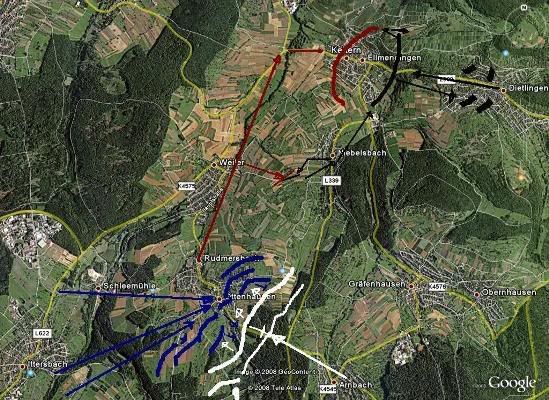 important phases of the battle

0 comments:
Post a Comment