On 2 March 1806, the two powers declared that they would honor the alliance with the Empire. The 29 40000 Swedish men landed in Denmark to join the imperial quotas, an expeditionary force of 21,000 British soldiers but later landed in Amsterdam.
During the winter, the coalition had increased its staff now had 60,000 men under the command of Grouchy, Berthier had 29000 and 68000 Soult, however, France was forced to introduce unpopular levée en masse, while Granada, providing one million professionals in Europe alone, not needed. Churrisque had 23,000 men and Nasr III, who had taken over all operations of the Southern 106000. Adolfo d'Este hours commanded 11,000 men, more than 24,000 people of Ibrahim Bey. László Ferenczi had 50,000 men, Béla 16000. I could provide a co-belligerent in total 42,000 men. About 30,000 others went off in garrisons throughout the territory.
The Netherlands had a shortage of men between the actual losses and desertions of the Continental Army did not exceed 19,000 men; von Durrheim available instead of 48000 men, the Bavarian army had 35,000 men, but still probably would have lasted a little. Knut Pedersen commanded the army of the north, 42,000 men, 29,000 men were still a Prussian army. The emperor had ordered the lever in the mass, but his vassals, however, were reluctant to commit in search of men, predicting that with such a large number of men in the enemy camp would mean enormous bloodshed, who had not abandoned the emperor, now coming more and more reports of armed hesitated and took great time.
Bavaria and Nassau
In April, Ferenczi and the Ottomans began the invasion of Bavaria, leaving Béla guard in Bohemia. In Bad Aibling Willing and the Bavarian army was annihilated by the overwhelming enemy, and the Duke gave up. Bavaria became occupied territory.
Simultaneously, the army of Mainz, who now had become untenable by the people, he tried again battle against von Durrheim. The defeat of Lahnau was aided by the defection of the quota of the Prince of Nassau-Weilburg, who had been promised independence, raising to a grand duke and the extension of its territory under the old dynastic claims. Defeated
von Durrheim, with the annexation of 14 May, the Prince became Grand Duke Friedrich Wilhelm of Nassau, removing power to the collateral branches of the family and tripling its territories. Two armies were quickly recruited, one in Saxony and the other centered on the principality of Lippe-Detmold, where Prince Ferdinand had inherited all the neighbors of the original domain, except bishoprics thanks to a careful policy of marriage in the last two generations.
Netherlands
Grouchy marched in March to Leyden, where he had joined the military forces of the Allies. The armies met in Wassenaar, but there were no winners. David Dundas's army managed to stop the French attacks, but both armies were dropped during the night. Grouchy was finally able to win when his supply wagons were able to cross the floods caused by heavy rains of the year and defeated the Allies, taking Leiden, but dovendoli retreat to leave Amsterdam.
was indeed the big issue of that war: the nations involved had understood early on that the theater could never sustain all those men, and every army had to rely up long columns of supply that goes a long way and slow down any movement. After
Leiden was still the stronghold of Haarlem. Lengthen even more supply lines would take another month or so, fighting against the partisans and the Orangemen Mariniers raids. This would have been sufficient to Haarlem to strengthen and allied troops to recover. Grouchy
devised a plan to get supplies quickly and then close the town in a vice. The fleet, once eliminated competitors, should have landed enough material for a month and the siege guns on the beach of Zandvoort, near Haarlem, the ideal place to download large quantities material despite the lack of port.
Having also the authority to order the Navy to seek confrontation, Grouchy requested that the fleet negotiates the Royal Navy. The combined fleet left the port of Antwerp recently. The idea was to capture the British fleet of Admiral Nelson at the port, but a sudden storm in the Channel prevented ships from Portsmouth, and gave time to block British ships to prepare calmly. On April 29, Nelson found himself over the English Channel and defeated the enemy fleet, breaking the line of battle and forcing the enemy ships to the coast. Admiral of Granada, Ignacio Navarrete, died in the crash were captured and four ships of the line, three garnets and one French.
The defeat prompted the parliament grenadine to allocate funds for other ten ships of the line; Grouchy instead saw broken eggs in the basket and was forced to march, paying attention to the lines. Laid siege to Haarlem on May 2. The 6 existing Anglo-Dutch army was approaching. Despite the attack on two directions, Grouchy was successful and, in addition to again defeat the allies, he obtained the surrender of Haarlem. On June 15 the army had recovered to make progress in Amsterdam. A department of Shadows, helped by the Republicans Dutch s'introdusse in the port of Amsterdam, making it explode stores of gunpowder and burning others, a small group also managed to assassinate the commissioner of the port, Bekmaar. The raiders had heavy losses, but managed to create havoc in the city.
A new attack in July, instead struck the city fortifications. Gaining two advanced redoubts, opened the way to the final assault, which captured the city on July 15. Although the patrols at sea, the government had moved for several days in Sneek, in Friesland.
The war in Asia
Until the arrival of Great Britain and Sweden, the war in Asia was limited to a few skirmishes and naval battles. On October 3, 1806, 4,000 soldiers besieged grenadine Palembang, after beating the local militia. Later, soldiers besieged Jakarta 10000. Occurred a few fights, dictated by the difficult terrain, the border between the UK and Granada in Borneo. The border between Vietnam and mainland British possessions remained rather quiet. On 15 November the Swedish fleet was destroyed in Liat.
In January 1807, in full monsoon, the Dutch soldiers and auxiliaries Luhou conquered natives, the French capital of Celebes. Subsequently, Palawan was occupied.
In April of that year, the Sultan of Delhi besieged the Dutch Cuttack, but the siege proved unsuccessful with the gunners grenadine. In May, the admiral Salmudi seized al-Flores, Timor, however, General Van Der Juns landed and drove the invaders from the Swedish three months later.
Sumbawa was attacked from the sea, but the shore batteries prevented the landing.
Palembang was captured and with it the smaller towns subordinated to it, but Jakarta stood until 1808, when it was decided to withdraw the undertaking.
In 1807, the port of Dutch Ye, Burma, was bombed and occupied by a combined fleet of Granada and Delhi. However, the return to the Dutch fleet of 45 ships in the Indian allowed him to take it back by defeating the Allies. At the end of 1807, a division grenadine was sent to invade the British Malacca, but was stopped by the theater of war, disease and remained motionless.
Africa
The capture of the post that brought the news of the declaration of war gave him the benefit of several months in Granada, in part because Swedish European fleet was unable to venture beyond the British Isles. Governor Khalid Awaale Dalmar with 3000 Swedish troops invaded Africa. He conquered the fort of Naftagor on the road to Kisimayu, but the force proved too small to continue and we had the stall until 1810 when, with 7000 men defeated the Swedish defenders and auxiliaries, winning Kisimayu, then return to the point of first, when the support of local tribes vanished.
In 1808, the Marines and Turkish assault brigade in Gujarat conquered the English settlement of Lawrence Marquess. The commander, Mustafa Emir, expelled all English residents and deported to an area north, still independent from Zimbabwe, where founded the city of Mozambick.
To the west, the invasion of the Congo had been delayed until 1807. In that year, 20,000 men, including the Guard and Askia French volunteers, tried to overcome the resistance of the Congolese soldiers, but they always managed by implementing the guerrillas to stop any attack. The English fleet landed at St. Helena, the fundamental basis of the marine enemy countries to double the Cape of Good Hope in 1809. A year later, the fleet was able to retake possession of Granada.
America
Hostilities began immediately, with the shipment of Philippe Lafronge against the Dutch territories in North America, which destroyed most of the settlements, and Dutch natives. Even in Guyana
Dutch were fighting hard and bloody, so that the irregular French, in addition to beating the English invasion of the South American territories meant that it forms a no man's land, up to 150-200 km wide, between Guyana and French Dutch Guyana, forcing the settlers. From the beginning of the war, easily the British occupied the territories in America grenadine and tried, unsuccessfully, to make Madeira. In 1809
was attempted invasion of French North America by the British in both directions, but after months of marching the French colonists were easy game to wipe out the British.
With the Act of Troyes, which gave the French ex-slaves all civil liberties but the right to emigrate, many riots broke out in 1810 in South America, English and Dutch, fomented by French agents. The majority was suppressed, but in both regions, the pro-French managed to resist until the end of the war: that the Holy Spirit (Espirito Sainct in Creole), with Victorya capital, and that of Assuntion Fort in the north. With the help of volunteers and materials Iberian and French, these two new territories were French enclave throughout the war.
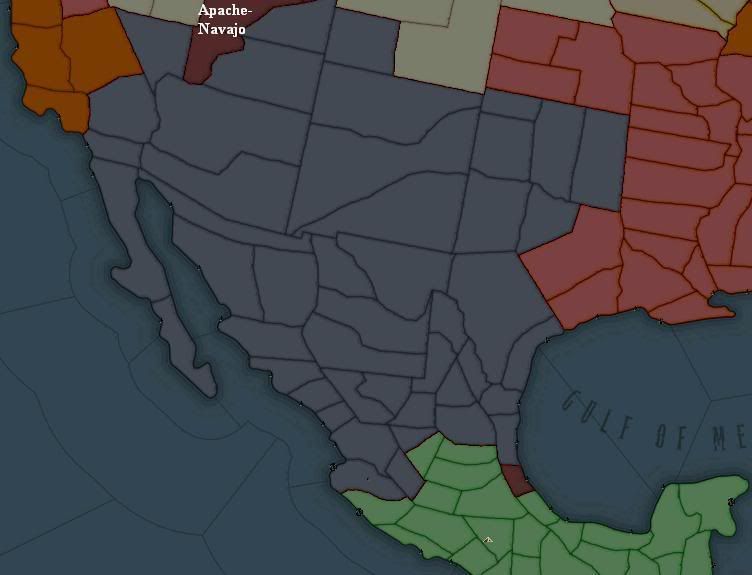
Also in 1810, the Aztec emperor was persuaded to go to war against France. The governorate is French, however, managed to repel the British landing is soundly defeated in Durangue the Aztec army, whose general overestimated Nochtli the newly formed cavalry Aztec, which was overwhelmed by the few present French lancers, who routed the Musketeers too few, leading to the defeat and a new peace treaty, in which half of the lands of Zacatechi were ceded to France.
| ||||
| | ||||


0 comments:
Post a Comment