Hoping to open a new front in view of the victories of Kutuzov also outnumbered the Russian government decided to devote even more tenaciously to the southern front. Meanwhile, after nine months, yet France and Granada did not seem able to pose a serious threat to Kutuzov (which, however, soldiers were sent from Finland, because now we were content to maintain what has already been taken).
The Fall of Bohemia and Austria.
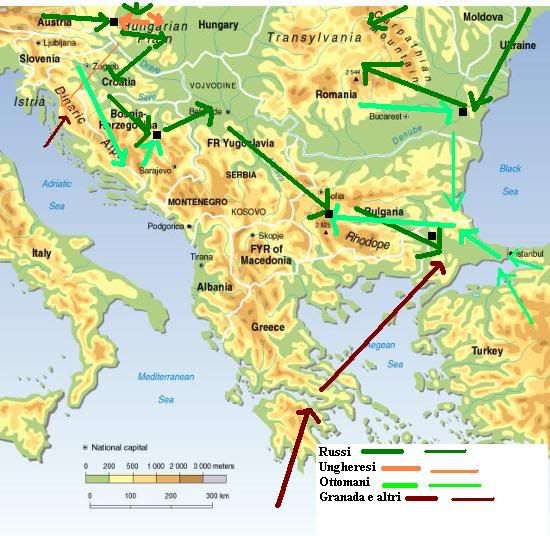
Propedeutico to this plan was first hunt Turks and Hungarians from Bohemia. In September of 1809 Dokhturov with 87,000 men attacked the nation again, this time defeating both.
In this predicament, the allies agreed, and retired in Austria, while the Grand Duke Jan Joseph worked with the Russians.
A month and a half later, having understood the movements of the enemy, The Russian general was able to isolate the Ottomans and beat Mistelbach, leaving the Hungarians threatened the right flank: the defeat of the Turks, Ferenczi ordered to return to Hungary to defend it. The invasion of Hungary
Meanwhile the Austrian Grand Duke fled to Verona, Dokhturov occupied the Grand Duchy, and he pursued the Turks. 35,000 new troops invaded Hungary from the north-east, in Transylvania. A part of the army of Dokhturov pointed the Veneto, but the army of Aldolfo d'Este prevent the invasion.
Ibrahim Bey returned quickly in the Ottoman territory, and left Hungary alone. Although
inflicting many casualties, not the general Fodor managed to counter the invasion of Transylvania, leaving the entire eastern Hungary to the Russian market.
Ferenczi tried to resist Dokhturov preventing cross the Danube, but the shock was such that in Komárno the Russians not only managed to build three bridges under fire from Hungary, but also to defeat the enemies. Permanently lost Slovakia, Ferenczi two days after he tried to take advantage of the river behind the Russians to attack the nearby Tatabanya.
The battle was a disaster: 4 / 5 of the Hungarian forces fell or were taken prisoner, because the whole body Russian had already passed the Danube at that time. The Russians conquered Győr and easily led the Magyar army to retreat to the west, allowing them to occupy Budapest.
After these events, the Hungarian forces were in chaos: in addition to the many fallen troops from Moldova and Transylvania remained deserted, while the Croats and Slovaks were for the most faithful, most of the equipment the army had been lost in the retreat , and many soldiers did not even have the rifle. Especially, with the taking of the capital, the opposition to Ferenczi found new strength and leaned to the Russians.
The king, now with less than 20,000 men, took refuge in Istria. Now the allies worked to help at least what remained dell'alleato Magyar: A division was sent to Tunisia in Istria and several tons of guns and small arms were shipped from France and Granada.
campaign Bosnia and Serbia
But the Russians had no intention of conquering the last part of Hungary not occupied: Dokhturov left enough forces to cover borders and Venetian Istria and marched further south, which enjoyed strong anti-laszlisti.
With the new park of artillery captured the Hungarians conquered the Ottoman border forts before Ibrahim Bey arrived. And the general turkish succumbed in the face of the Russian armed, losing to Dragelji and being killed in battle.
The dispersion of the Turkish forces in Bosnia gave way to the Balkan independence movements. It was proclaimed in Sarajevo Principality of Bosnia, which was followed to Herzegovina. Meanwhile, puppet governments were placed in Transylvania and Moldavia.
Dokhturov no resistance and was able to send two divisions to take possession of Vojvodina, where again the locals showed very friendly. The siege of the Turkish garrison in Novi Sad lasted a month before their surrender.
Here are highlighted the military problems of the Ottoman Empire: Despite efforts to improve its military apparatus, the ability to arm and train the conscripts was minimal: many regiments enrolled in those months were forced to resort to weapons.
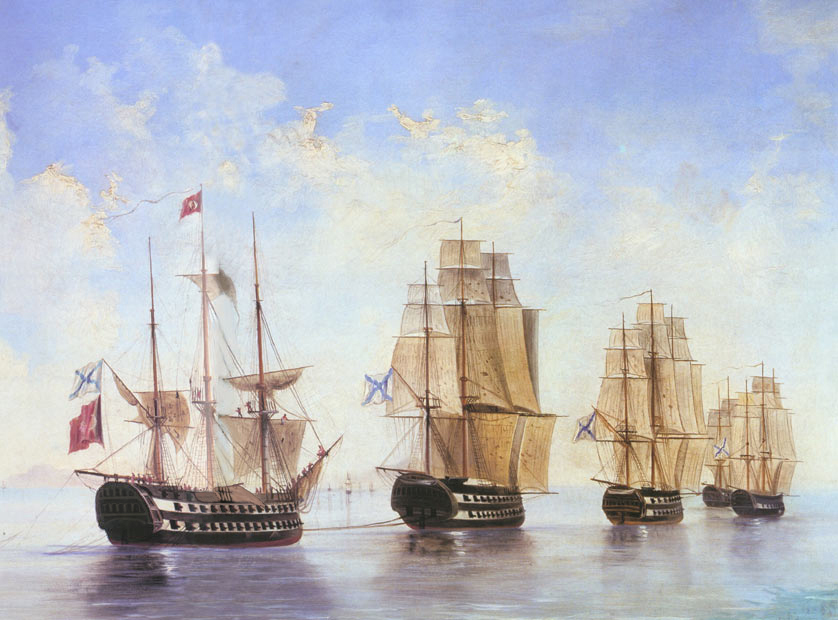
In December, the Russian fleet attacked the Ottoman detachment Sukhumi, destroying, and then pointed toward the Bosphorus. The battle that ensued, with Turkish ships, garnets, Egypt and Tripoli was able to stop the attack from the sea.
Nevertheless, the Russian did not stop running: at the end of December, the rest of Serbia was freed from the empire.
Dokhturov seemed unstoppable. The sultan decided to send the bodies to better address the Russian army. Granada sent three divisions from the Maghreb, most other reinforcements came from Tripoli and Egypt. The new troops, initially sent to Greece because it was feared that nationalism would greek again sparked the riots, it proved unsuccessful, because the Russians instead of pointing to the south, they headed to Bulgaria, where for months the Russian agents stirred local nationalists. While in the middle of winter, the march was overwhelming in this case. Moreover, in February, 23,000 more men ridiscesero the coast of the Black Sea, Constanta after having swept the besieging troops remained to defend the region.
On 28 February 1810, 40,000 volunteers between Russians and Serbs, Bosnians, Bulgarians, Montenegrins and others met in Gelvere 74,000 Turks, including the bodies of the Janissary and Sipahi in full force. In ten hours of fighting in the snow, the turkish army was routed and the elite of the weapon decimated by Russian cavalry, On that occasion, ruled virtually alone the burden of battle. The outcome was disastrous for the general Tahsim Hikmet, who had to abandon the whole Bulgaria, Constanta was taken while it was raised against Wallachia and Istanbul.
 Siege of Constanta
 At this point, the capital itself was in danger and Arabic reinforcements were on board in a hurry to Thrace. Fortunately, the main Greek independence is not trusted the promises and return the Russian revolution.
The commander in chief, Ali as-Sahl, therefore had a force large enough soldiers between Granada, Egyptians, Libyans, Greeks and Albanians, but much demoralized from the defeats of those months.
But neither the Russian general had everything easy, as well as his army is made to feel distance from home and the long months of the campaign, even if the taking of Wallachia allowed to shorten supply lines. However, he knew that the campaign would have been useless if he had not threatened at least the Bosphorus, and so continued to go south. As-Sahl began defense of Edirne, and gave them battle, April 7. In this case, the infantry was able to reject the Russian cavalry, and although the failure of the auxiliary as-Sahl imposed to abandon the field, Dokhturov lost a large number of soldiers. Laid siege to Edirne, but two weeks later, the return of the enemy fell back.


0 comments:
Post a Comment