Sunday, December 14, 2008

J Crew Sweaters Shrink

1810-1811: the fightback.

Dokhturov without enough forces to attack the heart of the Empire, he retired in Bulgaria and then abandoned as well, to return to Serbia.

Germany
Meanwhile, the armies in Western Europe were not left with nothing. All enemies of the Russians had reorganized their managers and the organization, adopting, as already mentioned, the organization corps and improving logistics.
On 2 March 1810, a ceasefire was signed between France, Granada, the UK and Sweden, which lasted until the Russian threat had been present. In April

landed 22,000 British and 32,000 Swedes in Friesland crossed the Kattegat to join the garrison remained in Denmark. Soon after, the French returned to the attack and grenadine.

The march was fast in the early days: Kutuzov, surrounded, abandoned the regions immediately adjacent to those occupied by the enemy and moved east, leaving Saxony to his fate.
The Saxon army attempted a last defense, which was easily won. British and Swedes from the north German allies were right to Kutuzov, France and Granada took up the occupied territories last year by the Russians. However, Kutuzov's army intercepted Swedish, which was the fastest, the Goldberger See in Mecklenburg and defeated, regaining Schwerin and causing the British to stop.

Again, the Allied advance slowed, in this case because they had to re-occupy virtually all the territories lost; Granada's army entered Austria and Nasr divided his forces, headed by a half in Slovenia and sending Osama bin Bohemia ; the French army instead went compact enough to the east.

Bohemia Osama Bin
, when he came to Bohemia in June, she found herself having to fight not against the Bohemian army, disbanded after the flight of the Grand Duke, but against a guerrilla war began after the proclamation of the republic. The pro-Russian factions, armed excellently during the occupation, the resistance began with an attack on the new interior minister. Having failed, they went down in guerrilla warfare itself, usually against the Republicans collaborators (being also a democratic but pro-Russian faction), sometimes attacking the army grenadine.
The general, according to the orders received, leaving 5000 men and proceeded north. This force was engaged almost to the end of the war to fight stiff resistance, due to the fact that General Mexien supported the German Bohemians, the faction that was richer and therefore more throat to the other in their claims to power.

Hungary
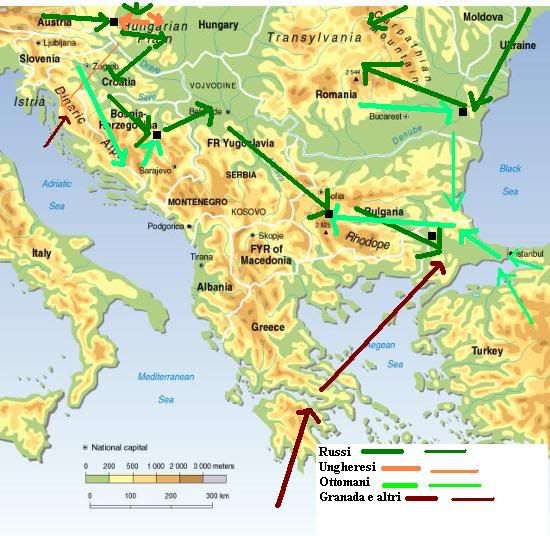
Nasr army attacked Slovenia together with Veneto and Emilia led by Adolfo d'Este, capturing Maribor and then defeating the Russians in Celje. Nasr went on to Hungary, while Adolph walked to Dalmatia, where he met with the forces of Hungarian king, who had been trapped in that region. However, even the anti-laszlisti were well organized and armed the guerrillas used to slow the Andalusian kings, while Dokhturov quickly returned north, leaving only two corps to defend the southern Balkans. Against all odds, in August, the Russians stopped the offensive, with the help of their partisans, only losing the Carpathian plain north-western Croatia and western Bosnia.

Eastern Europe
Kutuzov had defeated the Swedes and the British stopped, but she was forced to retire, to meet up with reinforcements coming from Belarus.
In July, only now the Prussian-Brandenburg was still in the hands of the Tsar. But the armies were scattered in the advance, so Kutuzov went to the attack, again beating the Swedes, and then re-Anhalt and defeat in the Franco-British army who had just finished the siege Magdeburg. The ongoing skirmishes
it referred to his enemies allowed him to remain in Prussia until October, despite losing many miles of territory (and Berlin in September).
But the arrival of three army corps reinforced Kutuzov allowed to defeat the enemy in the bloody battle of Chodzież, after which he returned to Prussia and forced opponents to stop and regroup. Winter comes, they stopped operations.

Balkans
To the south, until September 1810, Bulgaria was occupied by the Russians as the main effort was to arm and train, according to the standards desired by the Sultan, the thousands of recruits from the east. In September, then the army clashed against the army of Putschoff, winning, and these retired in Wallachia, leaving it up to the new Balkan states to contend with former bosses.
But even in this case, the resistance of the separatists (favored by zero tolerance of the Ottomans) to commit the allies until 1811 forwarded. Hajduk's practically neutralized the force of the weapon in the Balkans, by preventing the encirclement of Dokhturov.

's defeat Dokhturov
Finally, there was reason for the Russian firm in February 1811.
While other theaters in the country were already finished, Dokhturov want to take advantage of the uprising of Szeged to attack Nasr. The army
meeting the Russian Granadina north of Szeged dawn on February 3. Dokhturov available to local conscripts and 41,000 Russians, most anti-laszlisti 6000. Nasr instead had 36,000 veterans of campaigns in Germany, 2000 and 14000 riders Tunisian Hungarians.
The battle took place during a heavy snowfall and because of her sides meant that the Hungarians found themselves face to face, plus the anti-laszlisti had ocher uniforms of the regular army, with only a white handkerchief around his neck to stand out. In the woods on the left side, the battle remained static for several hours, a few discharge of musketry, confused orders and attacks with cold steel of the few times we differed, and the rest of the battle proceeded with difficulty.
After the pressing demands of Béla, Nasr sent the Guard on the left flank, where he managed to escape the pro-Russian (many reports speak of friendly fire) and then defeated the Russian cavalry grenadine, allowing the encirclement of the Russians, that had to fall back on the lake Fehértó. Nasr, taking advantage of the presence of batteries riding facilities, completed the massacre by bombing the frozen lake. Two days later, hunted by the Andalusian cavalry, the army of Dokhturov surrendered with the honors of war.

Cut Sweetness In Chili

The last few years

[B] The last few years [/ b]

1811, despite all the difficulties, it seemed favorable to the coalition to stay ahead of the Russians.

[i] The campaign of the Baltic [/ i]
Taking advantage of an early thaw in the Baltic Sea, the body of the Swedish invasion in March landed in the Baltic lands occupied by the Russians and freed them all in three months. In April, they were also liberated all occupied regions in Finland start a war.
But uniting all the forces on the Swedish Baltic Sea, Sweden was unable to attack St. Petersburg.

[i] The Pyrrhic victory of Kutuzov [/ i]
Also in March, Kutuzov resumed operations, attacking the British in Belzig.

The defeat of yet another general, however, is of little McKeith: converged on Berlin from the south French and grenadine, which Kutuzov was able to meet and march in step forced on Grubensee.
Here too, the caution, and Osama bin Soult led their armies prevented the deal a final blow to the Russians: while fighting Osama bin between the lake and Limsdorf, not Soult took advantage of the error made by Kutuzov, who Tormasov had sent too far north and attacked the exposed flank of Marshal and confined himself to seize a small deposit divisional Lindenberg, and when he learned that Kutuzov's French hussars had been spotted, had ample time to sort rpiegamento, because Soult had stuck to the news that the vanguard of Tormasov some regiments had attacked a Rietz-Neuendorf. This attack
Tormasov was blocked by the general when the order came to return to Berlin, but was left a screen Cossacks delayed by several hours the chase.
The next day, noted that, unless we fight in the city itself, could not defend Berlin against an enemy without another army approached the city. So, he left Berlin on March 28, bound for Poland.

Even in that case his enemies were able to exploit the opportunity because, after the occupation of Prussia, disagreements arose between the two sides: France and Granada wanted to continue in Poland, Sweden and the UK were planning to land at the mouth of the Neva, St. Petersburg and then to take aim directly at Moscow.

[i] campaigns in Poland and Wallachia [/ i]
Even before the armies of the past, new Polish borders, a new crisis had hit the Armed Forces of Granada distant past six years, the king was called loudly at home. Torres, whose government was experiencing difficulties due to the different duration of the war, needed the stabilizing presence of the sovereign, but that seemed completely at ease in command of the army.
After the incessant prayers of his prime minister, the king began in May on his way to Granada.

In the same month the armies resumed their march. The seven entered in Poland and Osama bin Soult, 10 McKeith and Stålhammar; only Lovinho June 1, the replacement of Nasr, came from the south.

Kutuzov was ordered to withdraw completely from Poland, carrying with him the king. The abandonment of Warsaw by the monarch helped the occupation of Poland, into chaos. Was officially restored the throne to King Poniatowski, but for the moment the Government was effectively a military one. Kutuzov went to Belarus, but came back to hunt the attackers of Hrodna and stopped the advance until July.

In Wallachia the other hand, as-Sahl Putschoff defeated in June, to proceed and reoccupy all Valcchia. Hikmet and laying siege regained Constanta Odessa in January.

[i] The disastrous Russian campaign [/ i]
In July, the sergeant took up the Russian withdrawal, but this time by scorched earth, relying on the vastness of the Russian lands.
In fact, in the first month of march, by refusing the clash, Kutuzov was able to significantly slow down your opponents. Eventually the English and Swedish general, despite the negative opinion of France and Granada, who feared a decisive victory on their part too, marched to the sea, where they embarked for Sweden. Landing would be made as soon as possible, but the operation was delayed by the treacherous attack brulotti conducted by the Swedish fleet and ships incendiary.

The two allies, left alone, the march continued, more and more difficult because of lack of infrastructure and supplies, with the arrival of winter, the situation only worsened. A few kilometers from Moscow, Kutuzov attacked with all his men.

[i] The Battle of Zvenigorod [/ i]
On 3 November, the French hussars had arrived in the village of Lokotnya, west of Moscow, hoping to find some food hidden by peasants in the return leg. Having found very little, some patrols pushed into the forest, to Pokrovskoye. In that way they met a battalion of Russian infantry, which surprised them and massacred. The battalion went on the run and put the riders.
Around 13 to Onufriyevo, the Army Corps of Grion Division Ivanov met. The body of Grion, one of the most marked from the country, had to withdraw. Kutuzov, now informed that the French army was scattered among Tuchkovo and Sychev, with the troops disorganized and looking for food and shelter. Indeed, the problem would be to identify each French unit spread in that area.

The sergeant ordered two corps to move forward and meet the enemy, as he prepared to march the 5th Corps, when news came that the infantry Lovinho was coming from the southwest.
The arrival of the division of Mendez to Akulov, where stationed a battery riding facilities, taken by surprise Kutuzov, who believe the army of Granada back. The third army corps under his command, which was supposed to attack Tuchkovo, sent him to defend and summoned the Kubinka Sarzjin 50,000 men from the north, why attack the French.

[more]

Recording Studio Workstation Desk

1808: the burgeoning Russian north

early Russian intervention, the clerks of the allies had tried to convince the Tsar to accept the cooperation in the war, without success. Until July of 1808 the Russian situation remained ambiguous. In that month
Kutuzov ended the occupation of northern Prussia, Hungarians and Turks of South Prussia. Not having the authority with which formalize the occupation, the military regime was established.
was also made clear the position of the Russian empire had not entered the war in support of Granada, France, Hungary and the Ottomans, but to fight the sphere of influence given by SRI and Sweden and to avoid that if it was to create a coalition. Therefore, he was asked to leave East Prussia. With the predictable "no", the Russian general Dokhturov attacked with 57,000 new staff first Hungarians, beating them to Skwierzyna and then fell on the Ottomans, to Zawodzie. At the same time, Kutuzov invaded Holstein and Mecklenburg, bring down regimes.
then moves in Jutland, where he defeated the new expeditionary force, was not able to invade or Fyn or the other islands because of the Swedish fleet.

retraced his steps after placing men in the strongholds, to face the French and grenadine. The first to meet the sergeant were Churrisque and Berthier, whose forces were first divided and then defeated. Soult and Nasr was then the next, but you knew that Kutuzov was looking for the decisive battle and would have won, and easily found, considering the conditions in which their troops were: most of them alternates between garrisons and campaigns for the past three years, the supply lines were always thin and unstable, while Kutuzov had his troops fresh, strong, regardless of the weather and supplies. It was decided to retire. The army and residual Berthier Polish Legion slowed to cross the Elbe at the head of the Russians long enough to replace the deposits of the various armies. The decision was made to go on the defensive and abandon the Hanover and Saxony, pending military machinery resumption to work well. Grouchy had to leave town in the Netherlands only the local troops on the borders and position of the Batavian Republic.

Eastern theaters until June 1809
Defeated in Prussia and Silesia, the Ottomans and Hungarians returned to Bohemia. Adolfo d'Este in September was forced to return to Italy, being the ruler died, his brother Antonio. Also in September, Dokhturov defeated the Ottomans in the territory and penetrated almost to Prague, but was stopped by a hasty retreat of the Hungarians, who induced him to go back.
In November the Swedes landed in Narva and resumed, but without being able to go further. The Swedish fleet defeated just before the Russian blockade of ports due to the ice. In March 1809 61000
Russian troops invaded the Balkans and other 30,000 Ottoman Hungary. The Hungarian troops were able almost immediately to repel the invaders, but the general arrived to besiege Kryuzev Constanta, before being forced to retire. In February, however
Cossacks invaded the Transcaucasian territories the Ottomans. They were beaten by the great army Kalmyk, comprising almost 100,000 staff. After this victory, the Sultan crossed out the limits on Kalmucks for the celebration of Buddhist rites.

campaign Friesland
also Kutuzov had to stop for a few weeks. On September 4, resumed the offensive, dividend his forces in two. Kept it to himself and put 50,000 soldiers under the command of the remaining 20,000 Tormasov. The order was to invade Friesland Tormasov to diverge and the enemy forces, allowing a pincer movement of the main force.
Tormasov taken aback Grouchy attacking Groningen. Conquered the city, and a little defense to Beilen, where the French were gathering. Tormasov managed to divide the strength of Grouchy, attracting up to the division of Falze Opsterland pretending a pincer movement, while the entire Russian force that he found himself against the French commander. Annihilated the division, making her escape to the west, and headed for Grouchy, still waiting for the main attack from the north. While maintaining the numerical superiority, Grouchy was unable to oppose the Russian cavalry and September 26 Beilen cleared out, leaving the field about three thousand five hundred men against the Russians.
Despite the important victory in Beilen, Tormasov was always outnumbered, so much so that had to be sent reinforcements to control a thousand Groningen. Grouchy called
5000 Republican soldiers and while he returned to Zwolle. Tormasov instead he found the support of the Dutch monarchy hoped, since most had already fled to England. On 2 October, with contemporeanea Kutuzov went on the offensive and met again with Grouchy. The first skirmish came at the village of Ten Arlo, were followed by clashes between hussars and artillery horse Echten. A De Stüwe the Russians were slowed down by division and by the Dutch Limburg cuirassiers French, the battle developed between the various countries and the Russians were always able to repulse the French attacks, despite significant losses. At sunset, leaving Grouchy Tormasov retired master of the field, but unable to pursue him. Grouchy

Tormasov tried to break in mid-November, attacking at Assen, but his demoralized men were unable to win the Russian defense and there was nothing.


campaign
Kutuzov Kutuzov was more successful: the accomplice disporsione French forces, attacked surprising strength in Bramsche Berthier and annihilation. It then moves to the east, engulfing the rest of the French, who were routed after the battle of Melle. Better
did the strength of Nasr, when Saxony was allied with Russia, October 7, Nasr made the mistake of sending 40,000 men to what they believed to be the Saxon army in full, while only one wing. Churrisque defeated because the few men of Frisk before it takes hold of Detmold, but the main force together with the Russian army plunged Saxon grenadine, which was surrounded in the region of Warendorf. Building on a rainy night, the soldiers of Nasr managed to open a passage to Sendehorst, but the roads were in too bad conditions and the Russians were able to close the leak when they had to pass three more divisions. After a day of fighting, the rearguard grenadine surrendered.
Granada's army folded neatly on Dortmund and the French were at Münster. The losses mainly affect the morale of the Germans, and when entire departments began to desert, it was decided to send them back to the rear.

Kutuzov could not help but take advantage of his victory. In addition to the lack of success in Friesland, November 2nd the British landed at Emden and returned a little later the Swedes in Jutland. He returned hurriedly to the north, forcing the Saxony to return on the defensive (even if he could take Detmold Churrisque when he retired).
While the Swedes with peninsula, then easily took the Holstein, General Stuart stopped to lay siege to Hamburg, which was to become the mainland port of the Royal Navy. Thanks to this block in the siege, Kutuzov could regroup and also require Hanover to provide soldiers. 30, the British were defeated and fatigue were able to re-embark, with the (few) reinforcements obtained during those months, the sergeant then defeated the Swedes and freed Lübeck, but did not achieve more results.
Kutuzov asked several times his Majesty to send him more men, but between 1809 and 1810 and ran his goals changed from Central Europe, now more or less pacified, the Carpathians and the Balkans. The sergeant had to call in Hannover Tormasov in December, receiving only 30 000 men from the motherland, with which, however, freed the Holstein.

His opponents were not better, however. The long winter rest period was necessary to France and Granada to recover. Strategic Studies began to introduce the organization corps, moreover, since it began to run low liquidity in that part of Europe, the Shadows were sent on a mission to recover the cash arresesi divisions.

Chelsea Charms Where To Find Pic Sets

1809-1810: the burgeoning Russian south

Hoping to open a new front in view of the victories of Kutuzov also outnumbered the Russian government decided to devote even more tenaciously to the southern front. Meanwhile, after nine months, yet France and Granada did not seem able to pose a serious threat to Kutuzov (which, however, soldiers were sent from Finland, because now we were content to maintain what has already been taken).

The Fall of Bohemia and Austria.
Propedeutico to this plan was first hunt Turks and Hungarians from Bohemia. In September of 1809 Dokhturov with 87,000 men attacked the nation again, this time defeating both.
In this predicament, the allies agreed, and retired in Austria, while the Grand Duke Jan Joseph worked with the Russians.
A month and a half later, having understood the movements of the enemy, The Russian general was able to isolate the Ottomans and beat Mistelbach, leaving the Hungarians threatened the right flank: the defeat of the Turks, Ferenczi ordered to return to Hungary to defend it. The invasion of Hungary


Meanwhile the Austrian Grand Duke fled to Verona, Dokhturov occupied the Grand Duchy, and he pursued the Turks. 35,000 new troops invaded Hungary from the north-east, in Transylvania. A part of the army of Dokhturov pointed the Veneto, but the army of Aldolfo d'Este prevent the invasion.

Ibrahim Bey returned quickly in the Ottoman territory, and left Hungary alone. Although
inflicting many casualties, not the general Fodor managed to counter the invasion of Transylvania, leaving the entire eastern Hungary to the Russian market.
Ferenczi tried to resist Dokhturov preventing cross the Danube, but the shock was such that in Komárno the Russians not only managed to build three bridges under fire from Hungary, but also to defeat the enemies. Permanently lost Slovakia, Ferenczi two days after he tried to take advantage of the river behind the Russians to attack the nearby Tatabanya.
The battle was a disaster: 4 / 5 of the Hungarian forces fell or were taken prisoner, because the whole body Russian had already passed the Danube at that time. The Russians conquered Győr and easily led the Magyar army to retreat to the west, allowing them to occupy Budapest.

After these events, the Hungarian forces were in chaos: in addition to the many fallen troops from Moldova and Transylvania remained deserted, while the Croats and Slovaks were for the most faithful, most of the equipment the army had been lost in the retreat , and many soldiers did not even have the rifle. Especially, with the taking of the capital, the opposition to Ferenczi found new strength and leaned to the Russians.
The king, now with less than 20,000 men, took refuge in Istria. Now the allies worked to help at least what remained dell'alleato Magyar: A division was sent to Tunisia in Istria and several tons of guns and small arms were shipped from France and Granada.

campaign Bosnia and Serbia
But the Russians had no intention of conquering the last part of Hungary not occupied: Dokhturov left enough forces to cover borders and Venetian Istria and marched further south, which enjoyed strong anti-laszlisti.
With the new park of artillery captured the Hungarians conquered the Ottoman border forts before Ibrahim Bey arrived. And the general turkish succumbed in the face of the Russian armed, losing to Dragelji and being killed in battle.
The dispersion of the Turkish forces in Bosnia gave way to the Balkan independence movements. It was proclaimed in Sarajevo Principality of Bosnia, which was followed to Herzegovina. Meanwhile, puppet governments were placed in Transylvania and Moldavia.
Dokhturov no resistance and was able to send two divisions to take possession of Vojvodina, where again the locals showed very friendly. The siege of the Turkish garrison in Novi Sad lasted a month before their surrender.
Here are highlighted the military problems of the Ottoman Empire: Despite efforts to improve its military apparatus, the ability to arm and train the conscripts was minimal: many regiments enrolled in those months were forced to resort to weapons.

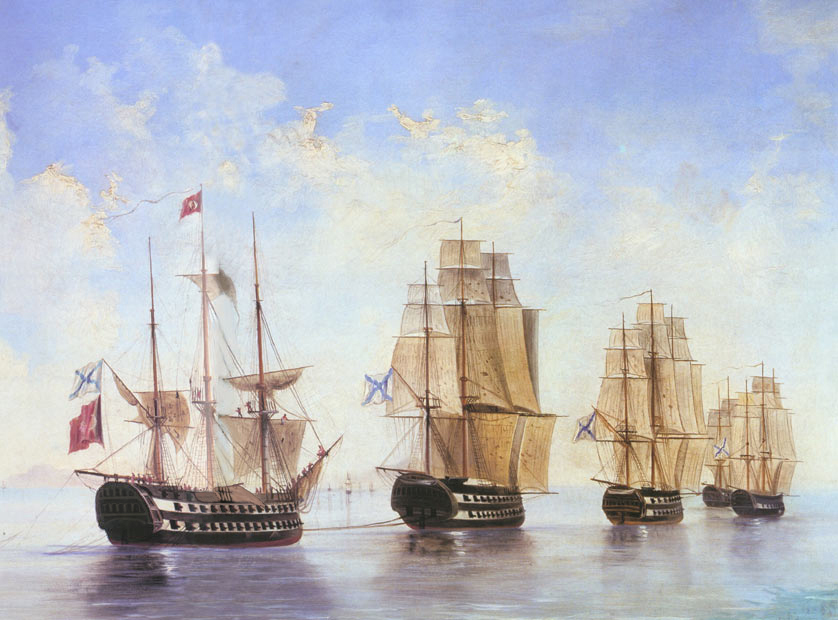
In December, the Russian fleet attacked the Ottoman detachment Sukhumi, destroying, and then pointed toward the Bosphorus. The battle that ensued, with Turkish ships, garnets, Egypt and Tripoli was able to stop the attack from the sea.

Nevertheless, the Russian did not stop running: at the end of December, the rest of Serbia was freed from the empire.
Dokhturov seemed unstoppable. The sultan decided to send the bodies to better address the Russian army. Granada sent three divisions from the Maghreb, most other reinforcements came from Tripoli and Egypt. The new troops, initially sent to Greece because it was feared that nationalism would greek again sparked the riots, it proved unsuccessful, because the Russians instead of pointing to the south, they headed to Bulgaria, where for months the Russian agents stirred local nationalists. While in the middle of winter, the march was overwhelming in this case. Moreover, in February, 23,000 more men ridiscesero the coast of the Black Sea, Constanta after having swept the besieging troops remained to defend the region.

On 28 February 1810, 40,000 volunteers between Russians and Serbs, Bosnians, Bulgarians, Montenegrins and others met in Gelvere 74,000 Turks, including the bodies of the Janissary and Sipahi in full force. In ten hours of fighting in the snow, the turkish army was routed and the elite of the weapon decimated by Russian cavalry, On that occasion, ruled virtually alone the burden of battle. The outcome was disastrous for the general Tahsim Hikmet, who had to abandon the whole Bulgaria, Constanta was taken while it was raised against Wallachia and Istanbul.
Siege of Constanta

At this point, the capital itself was in danger and Arabic reinforcements were on board in a hurry to Thrace. Fortunately, the main Greek independence is not trusted the promises and return the Russian revolution.
The commander in chief, Ali as-Sahl, therefore had a force large enough soldiers between Granada, Egyptians, Libyans, Greeks and Albanians, but much demoralized from the defeats of those months.
But neither the Russian general had everything easy, as well as his army is made to feel distance from home and the long months of the campaign, even if the taking of Wallachia allowed to shorten supply lines. However, he knew that the campaign would have been useless if he had not threatened at least the Bosphorus, and so continued to go south. As-Sahl began defense of Edirne, and gave them battle, April 7. In this case, the infantry was able to reject the Russian cavalry, and although the failure of the auxiliary as-Sahl imposed to abandon the field, Dokhturov lost a large number of soldiers. Laid siege to Edirne, but two weeks later, the return of the enemy fell back.

Cost Of License Plates In Ontario


The scandal of Lippe-Detmold
Despite the victories, it took time because the army was ready to march again. Only in September and
Churrisque Berthier could march in Lippe-Detmold. The new recruits were united army Durrheim, while Ferdinand led the 23,000 soldiers. A division was sent Churrisque Portuguese by Nasr.
Although now controlled only 20,000 men, Churrisque defeated Ferdinand at Sehnrath, opening the way to Cologne, easily taken.
Likewise, Sept. 21 win against Berthier von Durrheim. In the battle the German general was killed.
Berthier imposed to Prince Ferdinand to sign the agreement that makes the principle co-belligerent French and forced him to provide soldiers. The night before the signing, the prince tried to escape from Cologne to Münster, a city still under his nominal control. However, it was captured, the two generals realized that the main opposition force to the prince was that of the Republicans, whose presence in key posts had made sure all the conquered. Gave way to the demands of Republicans and gave them the prince because he was judged. He was found guilty of high treason, tyranny and crimes against the people. He was executed with great joy, also of the populace, with a recent French instrument: the guillotine. His son Leopold, Münster, became the new prince, even if minor. The execution of a nobleman by the people caused a sensation throughout Europe and was the result of exasperate the minds of both Republicans and monarchists.

Saxony
East of Cologne possessions started direct Emperor Otto VIII. For safety, he moved to Dortmund in Oldenburg.
Nasr and Soult's army now, moving from Nassau, marched on Saxony. Soult defeated the army of the Elector Bebra, forcing him to fall back on Erfurt. New armies were enrolled in Hanover and Prussia.
Siege of Erfurt, which is dedicated to the French, ran from October 2 to December 5, when the garrison, with the same elector, he surrendered.
Meanwhile, Nasr met with the army and the Swedish Brahe Pedersen. In the first clash against Pedersen, November 1, Osama bin men proved incapable of fighting in the snow already falling in that month. Again, even against the Swedes Granada suffered a slight loss. The solution was to reject the encounter, if not attacked first, as long as it was winter. So after Paderborn and Bockenem to Lauenberg Nasr got the retreat of the enemy after two days of attacks on its positions.
Another problem that arose was the food: the troops had already advised against Islamic practice sawm during military campaigns. Now, in northern Europe pork and alcohol were the food more easily available and useful to an army on the march. The preponderance of Muslim soldiers did not allow either to divide the food among themselves and other denominations in a balanced manner. Starting with the soldiers less pious and more hungry, slowly also bans food were abandoned in favor of more abundant food in the war. Even

Erfurt, he was finally taken, and the Elector Frederick Augustus III signed the act that made the Saxony area occupied and neutral in the war. Soult garnets and two divisions in January and they fought against Brahe Pedersen Nordhausen. The battle proved inconclusive. The capitulation

Netherlands
Grouchy, after Amsterdam, seemed unstoppable. Soundly defeated Dundas Kampen August 12, and Willem and Dundas in Meppel. After this defeat, Lord Greenville himself asked that the British soldiers were called home. The king signed the armistice on August 18 in Groningen and abdicated again, going to England. Daendels was recalled to form a new government of the Second Republic. Grouchy
would invade Hanover, but he needed more men, having lost many during the two years of campaigning, but these were needed in France, because they feared a British landing. The conquest of Hanover


When, in October, 15,000 German soldiers came to join the army of Berthier, returned the offensive. The army of the Lippe and Hannover, counting 32,000 men, was beaten to Melle. Prince Ernst tried to re Stadthagen battle, but was abandoned by his generals, who no longer wanted to fight the invaders.
Churrisque this time took the initiative and offered to keep the prince on the throne despite strong opposition in exchange for the establishment and support of logistics to the occupying armies, more the possible recognition of independence after the peace. Ernst agreed.
In the meantime, having fled the Prince Leopold, in Münster was proclaimed the Republic of Westphalia, France and co-belligerent of Granada.
The emperor sought an armistice, but was required to abolish the empire. He refused and took refuge in Denmark.

campaign Prussia
In November, the Ottomans and the Hungarians came in Silesia. The absence cohesion among the allies and the lack of Adolfo and Ibrahim allowed the Margrave Friedrich Wilhelm of Prussia to hit hard bey's army and then withdraw from the region. Slowly the army marched into Silesia, often looting, and then in Prussia and in southern Brandenburg, losing dozens of men a week to the guerrillas that the Prussian army practiced. Despite all the goodwill, the army had to stop with the rigors of January.


Skelaxin 800 Get High

The arrival of Russia's campaign north

Czar Alexander I, the first in 1808, decided it was his moment. Without having had any negotiations with Granada and the Ottoman Empire in February declared war on the United Kingdom and Sweden. Only ally was the protector of Poland. In March 9000 German men invaded Finland. Other 12,000 men invaded Karelia. Both sides of troops on skis, but the Swedes were more skilled and able to slow the Russian advance. Which could not but the few Imperial defenders.
In March, he left the invasion of Estonia, who fell, followed by Latvia.
On March 6, however, 70,000 Russians and Poles in 2000 commanded by Marshal Kutuzov Small invaded Poland.

The war on two fronts
The Russian declaration of war only increased the chaos that reigned in Germany.
You could not drive by the armies of Saxony and Brahe Pedersen, but the grip on the north was getting closer.
After Hanover, it was the turn of Holstein, which fell in February.
Then, the general chose to retire in Saxony, arriving on March 13 in Magdeburg.
British landed in 6000 and 10,000 Swedish Holstein, the Emperor Otto, however, began to want peace, while the allies were still convinced we could get at least a draw, especially because they were worried by the proliferation of liberal movements in Central Europe.
In May of 1808 new riots broke out in Aarhus, which suppressed the Swedish fleet.
Churrisque Berthier and failed to win the 16,000 body Shipping and 3,000 Germans and Danes, who found themselves before April. Soult was defeated on March 29, Brunswick lost. A month later, Nasr and Soult fought But Brahe Pedersen, forcing them to return to Magdeburg.

A new operations allowed the general stagnation in the German and Swedish evacuated Magdeburg between 2 and 4 May. The situation was critical, because Kutuzov had routed the Prussians March 21 in Görlitz. We found 200 km from Berlin, while the Allies struggled, the bridges were destroyed and the warehouses on fire from the Prussian Freikorps. The early Russian march stopped in Berlin, the Margrave was going to resist. For two months the Berlin defense withstood artillery Russian. Brahe Pedersen, moving from Magdeburg, defeated Ibrahim Bey and pointed Kutuzov to ease the pressure on the city, May 7, Pedersen was mortally wounded by an attack of Shadows. He was succeeded by the Hanoverian Albrecht Linn.
The plan was to divert Russian forces from the siege for long enough to Linn to supply new Berlin. Kutuzov, learned of their arrival, he left 10,000 men in small cities and marched around the enemy. The extreme speed with which the Russian soldiers marching in this case was also unsettling to opponents. Before they could stand, Linn surprises in Zehlendorf and defeated him with all his might. In the night marched south and attacked at dawn Lichterfelde the Swedes, finally beating them. Berlin resisted two more weeks, then gave up and Friedrich Wilhelm fled the city with the government.

The Russian success was due to the rapidity of movement, due to two reasons: the first was purely physical, as the soldiers were accustomed to run in all conditions and endure the toil and hardship, most departments do not even have any regimental tents for the soldiers, who often slept all'adiaccio.
The second reason was organizational: Kutuzov introduced a more rational division of the army above the division level, the corps. Each corps, set size, with actual infantry, cavalry and artillery, had its own logistics, its engineers and other services, making travel much easier for large armies.

Exile Emperor
The Fall of Berlin gave the Allies the opportunity to march to the north without the two best generals enemies; June 12 the expeditionary force was defeated. In Mecklenburg the army mutinied and began a revolt that led to the abdication of the Duke Friedrich Franz and the establishment of the republic. In July
riots broke out also in Kiel. The Holstein, theoretically fief of the Grand Duke of Denmark broke away and became a republic. Other soldiers Swedish and English were sent to Denmark, to ensure at least the Jutland. Faced with what was happening, the emperor decided to leave in Sweden, where he hoped to avoid the risk further.

Learn Indian Hand Embroidery

The intervention of the United Kingdom and Sweden

On 2 March 1806, the two powers declared that they would honor the alliance with the Empire. The 29 40000 Swedish men landed in Denmark to join the imperial quotas, an expeditionary force of 21,000 British soldiers but later landed in Amsterdam.
During the winter, the coalition had increased its staff now had 60,000 men under the command of Grouchy, Berthier had 29000 and 68000 Soult, however, France was forced to introduce unpopular levée en masse, while Granada, providing one million professionals in Europe alone, not needed. Churrisque had 23,000 men and Nasr III, who had taken over all operations of the Southern 106000. Adolfo d'Este hours commanded 11,000 men, more than 24,000 people of Ibrahim Bey. László Ferenczi had 50,000 men, Béla 16000. I could provide a co-belligerent in total 42,000 men. About 30,000 others went off in garrisons throughout the territory.
The Netherlands had a shortage of men between the actual losses and desertions of the Continental Army did not exceed 19,000 men; von Durrheim available instead of 48000 men, the Bavarian army had 35,000 men, but still probably would have lasted a little. Knut Pedersen commanded the army of the north, 42,000 men, 29,000 men were still a Prussian army. The emperor had ordered the lever in the mass, but his vassals, however, were reluctant to commit in search of men, predicting that with such a large number of men in the enemy camp would mean enormous bloodshed, who had not abandoned the emperor, now coming more and more reports of armed hesitated and took great time.

Bavaria and Nassau
In April, Ferenczi and the Ottomans began the invasion of Bavaria, leaving Béla guard in Bohemia. In Bad Aibling Willing and the Bavarian army was annihilated by the overwhelming enemy, and the Duke gave up. Bavaria became occupied territory.
Simultaneously, the army of Mainz, who now had become untenable by the people, he tried again battle against von Durrheim. The defeat of Lahnau was aided by the defection of the quota of the Prince of Nassau-Weilburg, who had been promised independence, raising to a grand duke and the extension of its territory under the old dynastic claims. Defeated
von Durrheim, with the annexation of 14 May, the Prince became Grand Duke Friedrich Wilhelm of Nassau, removing power to the collateral branches of the family and tripling its territories. Two armies were quickly recruited, one in Saxony and the other centered on the principality of Lippe-Detmold, where Prince Ferdinand had inherited all the neighbors of the original domain, except bishoprics thanks to a careful policy of marriage in the last two generations.

Netherlands
Grouchy marched in March to Leyden, where he had joined the military forces of the Allies. The armies met in Wassenaar, but there were no winners. David Dundas's army managed to stop the French attacks, but both armies were dropped during the night. Grouchy was finally able to win when his supply wagons were able to cross the floods caused by heavy rains of the year and defeated the Allies, taking Leiden, but dovendoli retreat to leave Amsterdam.
was indeed the big issue of that war: the nations involved had understood early on that the theater could never sustain all those men, and every army had to rely up long columns of supply that goes a long way and slow down any movement. After
Leiden was still the stronghold of Haarlem. Lengthen even more supply lines would take another month or so, fighting against the partisans and the Orangemen Mariniers raids. This would have been sufficient to Haarlem to strengthen and allied troops to recover. Grouchy

devised a plan to get supplies quickly and then close the town in a vice. The fleet, once eliminated competitors, should have landed enough material for a month and the siege guns on the beach of Zandvoort, near Haarlem, the ideal place to download large quantities material despite the lack of port.
Having also the authority to order the Navy to seek confrontation, Grouchy requested that the fleet negotiates the Royal Navy. The combined fleet left the port of Antwerp recently. The idea was to capture the British fleet of Admiral Nelson at the port, but a sudden storm in the Channel prevented ships from Portsmouth, and gave time to block British ships to prepare calmly. On April 29, Nelson found himself over the English Channel and defeated the enemy fleet, breaking the line of battle and forcing the enemy ships to the coast. Admiral of Granada, Ignacio Navarrete, died in the crash were captured and four ships of the line, three garnets and one French.
The defeat prompted the parliament grenadine to allocate funds for other ten ships of the line; Grouchy instead saw broken eggs in the basket and was forced to march, paying attention to the lines. Laid siege to Haarlem on May 2. The 6 existing Anglo-Dutch army was approaching. Despite the attack on two directions, Grouchy was successful and, in addition to again defeat the allies, he obtained the surrender of Haarlem. On June 15 the army had recovered to make progress in Amsterdam. A department of Shadows, helped by the Republicans Dutch s'introdusse in the port of Amsterdam, making it explode stores of gunpowder and burning others, a small group also managed to assassinate the commissioner of the port, Bekmaar. The raiders had heavy losses, but managed to create havoc in the city.
A new attack in July, instead struck the city fortifications. Gaining two advanced redoubts, opened the way to the final assault, which captured the city on July 15. Although the patrols at sea, the government had moved for several days in Sneek, in Friesland.

The war in Asia
Until the arrival of Great Britain and Sweden, the war in Asia was limited to a few skirmishes and naval battles. On October 3, 1806, 4,000 soldiers besieged grenadine Palembang, after beating the local militia. Later, soldiers besieged Jakarta 10000. Occurred a few fights, dictated by the difficult terrain, the border between the UK and Granada in Borneo. The border between Vietnam and mainland British possessions remained rather quiet. On 15 November the Swedish fleet was destroyed in Liat.
In January 1807, in full monsoon, the Dutch soldiers and auxiliaries Luhou conquered natives, the French capital of Celebes. Subsequently, Palawan was occupied.
In April of that year, the Sultan of Delhi besieged the Dutch Cuttack, but the siege proved unsuccessful with the gunners grenadine. In May, the admiral Salmudi seized al-Flores, Timor, however, General Van Der Juns landed and drove the invaders from the Swedish three months later.
Sumbawa was attacked from the sea, but the shore batteries prevented the landing.
Palembang was captured and with it the smaller towns subordinated to it, but Jakarta stood until 1808, when it was decided to withdraw the undertaking.
In 1807, the port of Dutch Ye, Burma, was bombed and occupied by a combined fleet of Granada and Delhi. However, the return to the Dutch fleet of 45 ships in the Indian allowed him to take it back by defeating the Allies. At the end of 1807, a division grenadine was sent to invade the British Malacca, but was stopped by the theater of war, disease and remained motionless.

Africa
The capture of the post that brought the news of the declaration of war gave him the benefit of several months in Granada, in part because Swedish European fleet was unable to venture beyond the British Isles. Governor Khalid Awaale Dalmar with 3000 Swedish troops invaded Africa. He conquered the fort of Naftagor on the road to Kisimayu, but the force proved too small to continue and we had the stall until 1810 when, with 7000 men defeated the Swedish defenders and auxiliaries, winning Kisimayu, then return to the point of first, when the support of local tribes vanished.
In 1808, the Marines and Turkish assault brigade in Gujarat conquered the English settlement of Lawrence Marquess. The commander, Mustafa Emir, expelled all English residents and deported to an area north, still independent from Zimbabwe, where founded the city of Mozambick.
To the west, the invasion of the Congo had been delayed until 1807. In that year, 20,000 men, including the Guard and Askia French volunteers, tried to overcome the resistance of the Congolese soldiers, but they always managed by implementing the guerrillas to stop any attack. The English fleet landed at St. Helena, the fundamental basis of the marine enemy countries to double the Cape of Good Hope in 1809. A year later, the fleet was able to retake possession of Granada.

America
Hostilities began immediately, with the shipment of Philippe Lafronge against the Dutch territories in North America, which destroyed most of the settlements, and Dutch natives. Even in Guyana
Dutch were fighting hard and bloody, so that the irregular French, in addition to beating the English invasion of the South American territories meant that it forms a no man's land, up to 150-200 km wide, between Guyana and French Dutch Guyana, forcing the settlers. From the beginning of the war, easily the British occupied the territories in America grenadine and tried, unsuccessfully, to make Madeira. In 1809
was attempted invasion of French North America by the British in both directions, but after months of marching the French colonists were easy game to wipe out the British.
With the Act of Troyes, which gave the French ex-slaves all civil liberties but the right to emigrate, many riots broke out in 1810 in South America, English and Dutch, fomented by French agents. The majority was suppressed, but in both regions, the pro-French managed to resist until the end of the war: that the Holy Spirit (Espirito Sainct in Creole), with Victorya capital, and that of Assuntion Fort in the north. With the help of volunteers and materials Iberian and French, these two new territories were French enclave throughout the war.
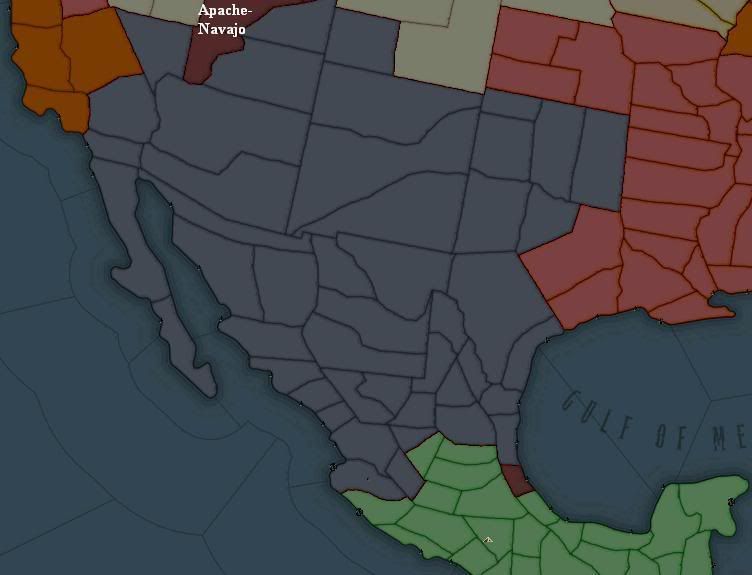
Also in 1810, the Aztec emperor was persuaded to go to war against France. The governorate is French, however, managed to repel the British landing is soundly defeated in Durangue the Aztec army, whose general overestimated Nochtli the newly formed cavalry Aztec, which was overwhelmed by the few present French lancers, who routed the Musketeers too few, leading to the defeat and a new peace treaty, in which half of the lands of Zacatechi were ceded to France.
change the border in Central


Trustee Release Of Liability

The fall of imperial

The annihilation of the army's southern Baden (24000 dead or wounded and 7000 prisoners), marked the collapse of the front, whose rulers had always been less favorable than centralized empire. Baden was captured Sept. 16 by a patrol of Shadows, in Stuttgart, where the Margrave of Württemberg had retired with the army defeat defined the terms of the armistice were separated in France, Granada, Baden and Württemberg. Ex-army commanded by Berthier and Churisque grenadine, with 42,000 men, arrived in late September in Mainz, von Durrheim forcing a retreat to rejoin the army of Lippe-Detmold, defeated by the new invasion force. This force was also part of the Polish Legion, about 5000 men led by Józef Antoni Poniatowski, nephew of the fallen king Stanislaw August.

On 3 October, the army-turkish-grenadine Magyar easily defeated the defenders in the Tyrolean asseragliatisi Passeiertal, in Moos. At the same time, the Swiss authorities, who had always maintained a number of institutional privileges, declared independence and co-belligerency with the coalition.

Ferenczi entered Austria without resistance.
Closed between two fires, Austria also surrendered.

The Treaty of Vaduz
On November 4, coallizzati generals met at the castle of Vaduz with key lords of the Empire who had surrendered: Duke Heinrich IV of Baden, Margrave of Elmar Württemberg, the Grand Duke Franz Joseph of Austria and the Grand Duke of Bohemia, Jan Josef. Instead, the delegates did not participate in the Swiss cantons, which deal separately with France and Granada.
The 28 points of the Treaty states that the German nobles would have their independence recognized by the powers of the SRI co-belligerent, and that would have obtained the territories they claimed dynastically. In return they would provide contingent of troops and supplies in case of need. Their domains were not considered occupied territories. The Swiss

question was more complicated: the Tagsatzung banned immediately after independence saw the clash of the cantons in which the interests outweighed those in rural and urban middle class which prevailed. The latter were in favor of maintaining the state of confederation had during the Empire, the others were for a strengthening of central power.
Louis XVIII supported the rural, normally pro-French and adapted to counter the weight of the new Germanic allies, the threat the withdrawal of French support to the League won him the centralizing, whose representatives met with the ambassadors of France and grenadine. He was granted permission not to contribute directly to the military effort (even though many volunteers enlisted in the French army), independence was recognized by co-belligerent and would set up a confederation (Swiss Confederation), leaving less freedom to the cantons. To balance it was agreed to put in the German capital Bern.
in December, was granted to the Duke of Sardinia-Piedmont in Vaduz as decided by others. In Lombardy and Veneto, however, remained a military occupation, and Turkish in the first grenadine, grenadine and Hungary in the second; Milan, Venice, Mantua and Verona were declared free cities.
The conquest of Zealand
With the capture of Sluis, a Dutch army Grouchy found himself in Antwerp, who had already opened the door and he immediately changed my mind and The army had also opened in the Netherlands. On October 5, Grouchy avoided the encirclement tried by Stadhouder in the fog and defeated him at Peisels en Verre. Again accepted the submission of Antwerp, where, however, stationed a garrison and returned to Zealand, where Willem had retired. The great advantage of the defenders was the fleet, which could defend the many islands, but the combined fleet ex-grenadine, high of 34 ships of the line and 13 frigates, was able to do battle with the Dutch outnumbered, Admiral Van Driesil surrendered the island of Texel, in Friesland after three days of fighting and losses of about 12,000 sailors and 3,000 Dutch allies. With the fleet
silenced, Grouchy began the invasion of Zeeland, Goes again met the enemy, preventing him from defending the town. Willem decided, after another defeat, to withdraw from the region during the retreat, not having enough ships to return to Holland, were captured about ten thousand men.

Uprisings in Germany
winter between 1805 and 1806 a truce was signed five months, during which the factions were reorganized and prepared for new battles. After the inconclusive battle of Kesselbach, north of Mainz, and Berthier Churisque returned to Mainz, where other real French joined them.
Emperor feared that the other lords of the Empire follow the examples seen, but that year was not yet abandoned. He opened negotiations with Russia and Poland to ensure the neutrality, but had no answers. Asked for help in Sweden and the United Kingdom, after lengthy negotiations in January of 1806 the two countries agreed to intervene. They had no success but the calls to the Papal States and to invade the kingdom of Naples from the south, because both states were too busy trying to suppress the internal strife and stabilize their economies.

The first riot took place in Switzerland in December 1805 in the cantons of Lucerne and Jura had taken place many requisitions of food for the French garrisons, and immobility in the face of the newly formed government, the few present Urbani took the opportunity to settle in the diets cantonal s'ingraziarono population and solving the situation of his own pocket, the success also led the Urban in Basel, Solothurn and Zurich to take up arms against the Country. The five cantons proclaimed secession and joined together in a federation, demanded the recognition of an independent entity. A few days after the two Aargau factions agreed to enter without conflicts in the confederation.
The Confederation of Zurich was not recognized by any nation. However, the cantonal militia was ready to defend the borders of the new state. Fighting in the Swiss Alps in winter, was not recommended, but the rulers believed in the game that would serve to demonstrate that any uprising would be short lived. Aargau was pacified by the French with relative ease, but on the heights of the series resistance was low enough to stop the offensive. Nasr then sent a regiment of light infantry Basque. Their uniforms were delivered adapted to the climate and the latest equipment for the movement in the mountains with the Order of 1498 was abandoned the prohibition of standard-equip the army regiments, or out of necessity or distinctions of merit.
The expeditionary force had some successes, but his numbers will inficiavia the efficacy. During the winter we added two companies of Chasseurs du Jura and a boundary of Piedmont, gathered in the Alpine Brigade.

In Baden Württemberg and the pro-imperial opposizone was very strong resistance of many bodies were formed, operating mostly in the countryside, often made by Jaeger, was sent to the light infantry and cavalry to help the regular armies. In the winter months were very bitter fighting in the forests and fields, especially the campaign was particularly difficult against insurgents in the Black Forest. Martial law was imposed in each region affected by acts defined as "banditry".

On January 2, Prague university students demonstrations for a constitution, the demonstrations degenerated when the army intervened and the students were joined by many people who generally criticize the government of the Duke.
In the days following further outbreaks were built in other towns in Bohemia.
László was favorable to the rebels and did not act, but the Duke was not going to give up and repressed the liberal movements, forced by the Allies, the Hungarian king withdrew his support and intervened in the region of Mount Jirny, where some soldiers had mutinied. When

yet there was hope that the revolutionaries were backed by Czech, the secret society of Köhler took advantage of the absence of the Duke of Bavaria, at his residence in Regensburg, to begin their own uprisings, January 13, Monaco, Augusta and other towns important. With the support of nearly half of Duke's army, 15 Bavarian Republic was proclaimed. Continued until late April in clashes between monarchists and republicans, with the intervention of the weapon of Count Axel von Weimar. The republic sought the help of the invaders, but in accordance with the agreements established no soldier crossed the border. In March, the revolution was over. In March

even secession Swiss had been put silenced: the Alpine Brigade and the regular army of the Confederation of the secessionists aggregatasi surprised the army in the plain of Laufen, ready to groped the last offensive. With the defeat in Laufen, the leaders of the revolt were forced to surrender.