When Prince Yusuf was crowned king, already at a mature age, the Age of Enlightenment, in principle after nearly jumped Granada, was now entered in its own right in the history of Granada. His reign was punctuated by the news.
The plague of Sumatra and Malacca
war of the same year of succession, a British fleet departed from the base of Cape Town and made a stop in the Dutch possessions in India. From there went back with the addition of the Dutch fleet. It was the surprise attack of the Netherlands and Great Britain against the weakened kingdom of Ayutthaya. In previous months, the Allies were added and the Lan Na Brunei. The Dutch army landed on the coast between Burma and the Malay Peninsula, the English on it. The armies of the Lan Na, which had consolidated its position by incorporating the Shan State after losing most of its territories in China, invaded from the north of Laos, after an easy occupation of Malacca, the troops of Lord Bullington went up north and joined those of Brunei, taking the northeastern coast of the kingdom, who went to the Sultanate. King Taksin of Lan Na Ayutthaya finally taken and destroyed, and the king fled to China Suriyamarin however, going to Cambodia and from there by the emperor, who, however, would not engage in any war.
With the annexation of the kingdom of Ayutthaya, Taksin proclaimed himself King of Siam and the British General proposed the invasion of Cambodia, divided into independent cities, or the Vietnamese faithful all'Ayutthaya: even in 1781 the region was annexed to the British Empire. This invasion of Granada
very worried, he did not want this new coalition in the area, so, when the Sultan of Johor (Malacca) showed too much friendship toward the British, 15,000 men he invaded the territory, as "strengthening border security and peace ". The Sultan accepted the submission without a fight.
But the Thai border with Granada convinced many to take refuge, followed by Cambodians. The governor made a big mistake, deporting all refugees on Sumatra: the crowding unsanitary conditions and did burst the bubonic plague, which expanded throughout the island, which fades only seven years later, when he had already invaded the islands.
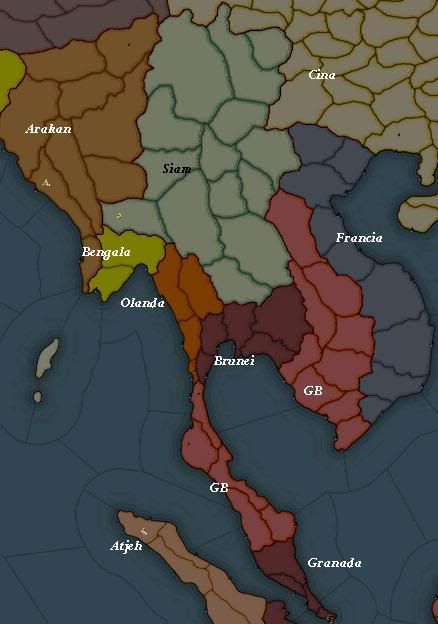 The new borders after the Vietnam War in 1788
 The economy and information
If outside the nucleus of the kingdom changed little in the economy, the inside was very done. The three bags that had previously existed, that of Granada, in Tunis and Kerala, were merged into the bag center of Granada, which allowed a better control over financial assets. At the same time, numerous statutes were revised in the workplace: they had many cities, often dating the Middle Ages. Wanting to encourage as much as possible companies, the government saw them all, with the support of the bourgeoisie, removing most of the guarantees to workers and halving times bureaucratic, and to secure the votes of the aristocrats were not affected the agricultural states. Despite this loss of rights and interests, the child laborers and artisans did not protest at first, because for centuries they had no need to use those statutes and they saw what would happen.
were then reorganized the tax classes: they became eight, including the first three did not pay the "fee for the defense."
In 1781, moreover, was founded the first newspaper in an eclectic character, the voice of truth. The government printed since 1648 a government announcement, which followed news of local government. In the 90 century started popping up independent newspapers, but always linked to limited areas. The Voice was the first newspaper that yes, it was based mainly on the Iberian Peninsula, but had big space for news from the rest of the kingdom and the world, opinion, and many other categories which are outside the record. 800 took the shape of modern, sharing in a major newspaper, coming out twice a month and a local daily.
The Constitution
constitutional ideas had already penetrated most of the ruling class of Granada, in response to the absolutist tendencies of Nasr II. Increasingly, groups of nobles and bourgeois, and spoke of it in the winter of 1783 in several cities were born real events that they asked. Yusuf then decided and put to the vote the proposal of a constitution, which was accepted. So a constituent assembly was formed in Zaragoza, who drew up the first two weeks in the constitution, that of Saragossa, in fact.
This constitution declared that al-Andalus was a sovereign nation and the umma and allowed them freedom of religion, association, speech and allowed the labor unions, but printing was still in theory open to criticism. Constitutionalized the division were in citizenship and the rights of ethnic minorities.
The second category of citizenship always voted according to the methods used, while the nobility of that class voted by following the instructions of the former, which were as follows:
-the right to vote was based on census: the first three classes did not pay the heavy tax on defense, but not Nor had this right;
-every seven years were devoted to the representatives of local parliaments, and these would no longer have power to elect their own representatives to himself, but every four years the same voters who said they would go to Granada;
- was allowed and even forced the association in political parties and factions to stand for election to the Council, or when we first appeared as tiny as individual candidates or factions both the local parliament and the Council. So mantendendo minor parliamentary divisions, the supreme chamber sides would present well defined and above transetnici;
-always to the Council, the seats would go to parties in proportion to the votes;
-king still retained the executive and legislative powers granted and guaranteed by prerogative and could dissolve the Council, as well as to prohibit certain parties, but his powers would stop this, because every other movement of power should have been voted;
-local parliaments could legislate in respect of their skills, but also had right to appeal to laws they did not like.
This constitution, though still lacks some things, like the ultimate separation of powers or the secular (not for the role of the sovereign), was very well received by his supporters and was a model for other constitutional experts in the world.
 The mayor of Santander, who read the draft constitution to the Council
 scandal courts
In 1783 the scandal came to light of some courts in the inner regions Saharan Africa, grenadine in theory by the law, had applied for many years the whole of the Sharia. Faced with this liberty taken by the judges, were created to ensure that the Special Commissioners more gifts and cultural ones, where not accepted in full by the central government.


0 comments:
Post a Comment