The revolts in the Ottoman Empire
As feared, the seeds of revolt was also placed on the imperative of the Sublime Porte. The secret society revolutionary Sons of Liberty began the revolt in Greece, Serbia, Bulgaria and Croatia, but had little success. While the army suppressed to the west, the Caucasus and sull'Elbruz turkish-armed gangs began to fight the Persian rulers, the forces that had fought in Europe in 1792, were moved to the east in early '93. Faced with this shift, the Greek population took up the rebellion, this time blown up by taxes imposed on civilians and the repression. A new wheel followed by Serbia, Montenegro and Wallachia. The Empire did not have the strength to fight all those riots, which were expanded to the Peloponnese and from there in Apulia and Calabria. Granada intervened: the proposal submitted by the royal party, passed a very few votes. Again
Pesniz had command of the operations: with 6000 men and 90 guns first landed at Taranto, where he joined the army and defeated the rebels Neapolitan Italian. Then re-embarked and went to Greece, entering Attica and freeing the Turks besieged Athens. With the arrival of new recruits Anatolia, who had quelled the small uprising in Ionia, invaded Peloponnese, while an army from Istanbul through Macedonia and struck from the north. In the summer of 1793, the movements of the Greeks and Vlachs were blocked.
Pesniz was about to march on Montenegro, when it was learned that the Mamluks had taken the opportunity and had declared its independence, as well as the Bey of Tripoli. Impudently, Pesniz decided to embark immediately for Egypt, where he arrived in the hottest season. In addition to land in Alexandria, already in poor hygienic condition for the siege, attempted an unsuccessful sally, because his men were exhausted from the heat. The city fell shortly afterwards, and only half of the survivors managed to reach safety during the attack on the Mameluke, the Pesniz fell into the same flight. Faced with
quest'insuccesso (in November, the Egyptian army had invaded the Sinai) and the victory of Tripoline bey, Mustafa decided to grant large autonomy granted to the bey and Lower Egypt as a vassal state to the Mamluks, who retired Government outside the region
The riots in Hungary and Italy
Again in 1792, cities such as Milan, Bergamo, Venice, Treviso and Novara rose, the imperial army, however, easily eliminated the threat. Also the army, led by the Earl of Coburg, passed the Hungarian border in June, to suppress the independence of Slovakia Hungarian, while the king was engaged József II against the revolution in Pest.
The Batavian Republic
Even the Netherlands, which had a reputation for being fairly liberal, were spared. In June 1793, the rebellion broke out in Flanders. The provisional government established its headquarters in Flemish Ghent and asked the French intervention, but did not. In exchange, the general Daendels, who had been fighting against the French Revolution, passed on the other side, refusing to attack Flanders. With this refusal, in most Dutch cities stadtholder revolt broke out and fled to England. The new government, led by Pieter Vreede, however, escaped the German invasion, renewing all previously signed agreements, but by many reforms.
independence in the United Kingdom: the American war and the revolution of August
Already in 1791, part of the English colonies had been raised against the homeland, without which the colonial troops could fight effectively. The advent of the Batavian Republic brought new life to the insurgents, well supplied by the Dutch. In 1793 in Sandusky, the seat of the chief Wyandot (or Huron) Dunquat, was signed the Great Confederation, formed by the Huron and the Shawnee confederation, both of which include many other peoples clients.
When the raids began in the British territories, the British agents tried in every way spread of smallpox, but did not have great success. In fact since the beginning of 1700 was introduced in Europe 's ashi, a practice that served to Anatolian immunize children against the disease. In the 80 century, the Dutch doctors were able to convince other native leaders to introduce even among their tribes. The protagonist of this "immunization" was Pieter van Woensel: mandate for political purposes by his government, took the opportunity to study the nature of the Americas and, secretly, a clan of Ottawa used to test the diphtheria immunization, without success. However, the gangs began to attack with good results. The colonial government, engaged in suppressing the rebels of John Adams, offered the alliance with several tribes, mainly independent of the Ojibwe Wyandot. Their contribution, however, was minimal: 500 militants Dutch, who lived between the lands of the Great Confederation and British allies, and a thousand warriors set out on expedition Potawatomi, defeating the enemy warriors and burning villages. In one year, the territories were occupied by the Dutch settled there tripled and there are many mestizos born in previous years.
the American war fits the figure of Samuel Wolff, an Anglo-Iroquois mystic, politician and linguist. Judge of the county, state theorized a division between the peoples Algonquian (as Shawnee) and strain Iroquois (Like the Wyandot). Thanks to the fame gained in politics and as a linguist, of Harrisburg, the governor appointed him to the task of convincing Dunquat to abandon the alliance with the young Tecumseh. All that the fifty Wolffe got was the killing in a surprise attack in the village where he slept. It is said that he died trying to persuade the warriors to save the children, but in the way the federal government to make war Iroquois was already in use for some time: in fact they were caught only children but also young adults.
It was in 1794 that broke the rebellion in Ireland, like all others of the period. Munster and Connacht declared independence. With most of its resources committed in America, the repression was fierce: the rebels were beaten in Munster, but the king agreed to grant to the Connacht semi-autonomy, with their own parliament and some freedom. Colin Moore, the leader of the rebels of Munster, however, fled to America, where undercover reached settlements north of the Parana River, the border between the Guarani communities and independent Ireland and Great Britain.
The war between the federal government, the American rebels and joined the Batavian Republic lasted until 1795, when General Howe defeated Adams and signed the surrender of these United Colonies. Meanwhile, the Dutch had landed in the southern part of British territories on the Pacific coast, the current California and had been conquered by the Federal Government had expelled the English settlers from the north of the Gulf of St. Lawrence. With the defeat of the rebels broke a violent motion of distrust and persecution of all natives residing in English, except the Iroquois, many Indians, especially Cherokee, fled seeking asylum to Confederation. Peace was reached in 1796, when a regiment from the West Indies brought cheer to New York, from which it spread, hitting Europeans and natives alike. England recognized the achievements of the Dutch and the confederate and the first awarded as an area of \u200b\u200binfluence and colonization of a vast area south of Michigan.
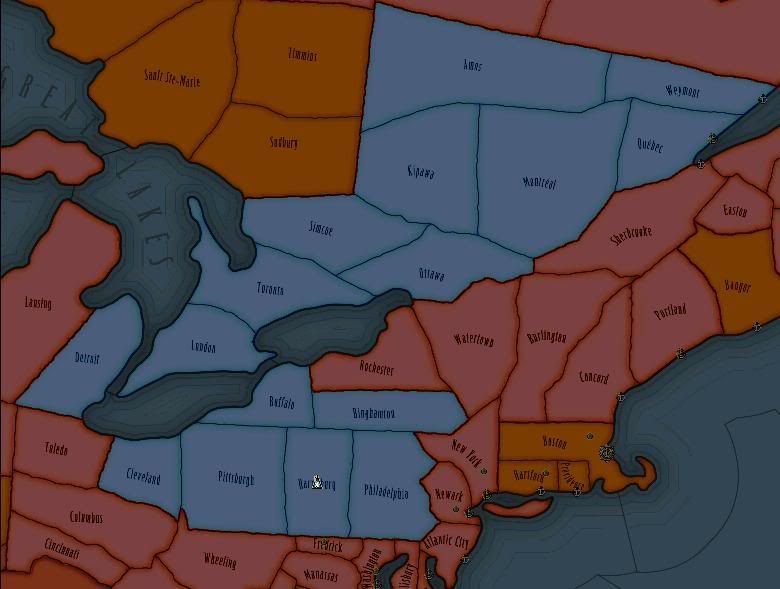 borders after the peace of 1796

0 comments:
Post a Comment