policy reform
Nasr II showed to the nobles that they had disposed of an "evil" for another. In fact, if Ismail had antagonized virtually everyone, Nasr could count on strong support from the army, navy and roughly all the noble Indians. However, the principle is very involved diplomatically. Temporized for some time in the face of demands to abolish the decrees of the father to avoid confrontation, personally ordered the suppression of revolts in the Ottoman protectorate of Italy and went on an official visit to Paris for over a year. Past year, it was 1736, he returned and proposed the new political order (with foresight, had convinced the Indians to be noble in Granada for the vote): the measure passed by the votes Allies of Nasr.
The reform provides for a more rational territorial division, both political and fiscal, in which all previous sheikhdom, county, or duchy would like to refer to larger corporate entity, with its own parliament and elect their representatives to the assembly (which Deputies were called), which was so diminished in number, but assured a constant presence in all regions of the kingdom. The provinces were then grouped under a "emir of the people." Although taxes were redistributed based on the new system.
The new "provinces" were:
Iberian Peninsula (there was no emir):
-Castile-Navarre (Basque and French)-Leon: 17 Members;
-Aragon-Catalonia: 15 Members;
-Portugal: 15 Members;
-Granada (Andalusian territories by majority): 20 members, headed by a Master of Toledo, who had double voting;
France and Italy (emir of Firanja )
-Poitou-Béarn-Armagnac: 8 Members;
-France border: 6 Members;
-Italy and Corsica: 9 Members;
North Africa (Maghreb emir)
-Fez-Tangier-Marrakesh 10 MPs
-Atlas 8 Members
-Algiers-Oran: 10 Members
-Tunis-Kairouan: 9 Members
Africa Coastal (emir of Africa Coast)
-Trarza: 5 Members;
-basins of the Senegal-Gambia: 7 Members;
Kpelle, Kru, Malinke, Fulani-: 8 Members;
-Bioko and southern centers: 4 Members;
internal
Africa (emir of Songhai):
-Songhai: 11 Members;
-Mali: 9 Members;
-Niger: 10 Members;
India (emir of 'India): Rajasthan-
: 9 Members;
-Gujarat: 11 Members;
-Maharashtra (costs): 12 Members;
-Sri Lanka-Tamil Nadu-Puducherry-Purba Medinipur: 15 Members;
-Somalia and Socotra 9 Members;
Southeast Asia (emir of the Spice Islands):
-Western Isles: 8 Members;
-Eastern Islands: 9 Members;
America (emir of the west):
Barbados: 2 Members.
Together, retired immunity to the veto of his father, but changed it to automatic approval of laws if 4 of the 7 emirates (or 3 and the Master of Toledo) supported him. Probably happy with the warranty of representation, few realized that the king was only minimante diminished in its strength: the Emir of India, from the nobility friend Nasr, was highly favorable to the king, the Emir of America, the power clearly spoporzionato than the population represented, was also related in some way with the royal family. The only problems could arise with the emirs of the Maghreb, and representatives Firanja Iberian, which still only worth per capita.
Thanks to this rule, he passed an edict in 1737 which earned the nickname of "the scourge of the aristocracy, thanks to the five emirates: first, the conduct of the navy and army, both professional and military service, was given only to those who had graduated or had previously attended the ' special academy. No more quotas controlled by the local nobles. Second, every noble would receive twice as much land owned at the time (taken from those owned by the crown), but they were abolished in state funds to maintain them. And with that, we drew a clear line: Gentlemen Indians and Africans were not affected much, but the Iberian nobility, who had been given to investment by making its land or starting other activities, found more or less the same condition as before, while those who had lived in rent, leaving their fields machined to a minimum, had a significant loss in stock: the costumes, as in other countries, imposed spending spree. Some noble
s'indebitarono to the bone, others had to sell their title or even escape. The internal dissent was strong, but in addition to the support of military cadres, the king also had one of the richest nobles, who had increased their holdings by buying those of their peers. It was thus to create a division for a long time maintained between nobles and rich bourgeois, more favorable to the royal power and the noble but less well-off who had managed to keep their territories forever osteggianti the royal authority.
Approaching France
Already Ismail IV, the relations between France and Granada were considerably relaxed, with Nasr, further improved.
In 1737, after the diplomatic mission, the two kingdoms were unofficially allies. The first test came a year later, when France used as a basis for the Barbados War Franco-Azteca, gaining after two years of fighting in the region of Matagorda Bay (the empire, in return, by obtaining a mutation in the smallpox , which hit the Caribbean and Mexico).
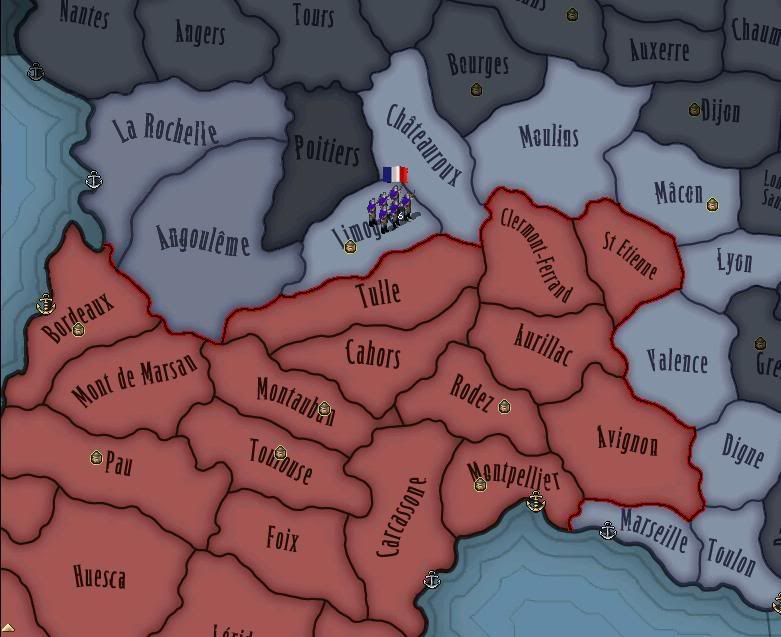
In 1742, however, the Treaty of Albi, France came in possession of the Frontier Provinces of France and Poitou, in change in the eastern part of Ceylon, whose invasion was imminent. In fact, the same year Granada withdrew the security on the island kingdom (the first given after the wars in the fifteenth century) and let the French landed in strength, easily conquering the last independent force on the island. General Delaville delivered personally to the governor Bagyan conquests and remained there until January of 1746 as a force of public policy.
| ||||
| | ||||


0 comments:
Post a Comment