Friday, February 8, 2008

How Long To Cook Cake In 6x2 Pans

The conflict with the Empire and Russia in 1700

War of Sardinia
In 1740, the death of the Duke of Sardinia, having married a noble of Turin, said the move was dall'egida French to SRI. This change led to the lord of war.
Although not formally allied with France, Nasr won the vote of the Council on the participation in the war, to ease the pressure on the Italian possessions: the fleet in June-October participated in the siege of Nice was grenadine, as well as the army took possession of Valencia. The brief war ended however, when the French king in October was beaten soundly in Schlettstadt: peace and accepted the transfer of Sardinia; Nasr, however, withdrew from the conflict, without ever having declared war. The Emperor, as they have the consent of the voters, not continue the war against Nasrid.

The defeat against Russia
Almost simultaneously, Russia, allied with Hungary, said war on the Ottoman Empire. With the goal of expelling the Ottomans from the banks of the Dniester, the Empress Elizabeth wanted to take control of Podolia, which was invaded by Count Christoph von Munnich, defeating the local army. A few months later, the Hungarian royal army laid siege to Rijeka.
suddenly attacked the Sultan asked for help to the ally, who proposed to foment never completely pacified the Crimean Tatars and land there. A turkish fleet defeated the Russian-grenadine to the Bay of Kinburn in 1741. 30,000 men were landed and they conquered with ease Kherson, before moving to the south. The entire
rebelled against the Crimea and Russia, for the winter, the peninsula and the city of Kherson were outside the control of Russian army of 60,000 and was ready to march north.

On the other theaters, the war was not so good for the Ottomans. Von Munnich conquered the city in November Moldova Betsy in January, the entire region of Istria was in the hands of Hungarian bands of robbers in the pay of Russia is pushing up their raids in Kalmykia. Threatened by a number of directions, and without sufficient men to oppose the Sultan summoned the whole army from the Crimea, and left again, he proclaimed himself khan to contend alone against the new Russian invasion: the massacres avoided by agreeing to go into exile with his subordinates.
Crimea's army, now about 27,000 men cash, was sent to Moldova, Hakimoglu to join the army led by Ali, who, however, lost the battle of Strasheny. Although it had been a Pyrrhic victory for von Munnich, Sultan hastened to accept the peace, handing Podolia to Russia to Hungary and Istria.
Battle of Kinburn.

Brush My Tongue And Cough Up Blood

Colonialism: wars and wars for the committee. The new policy

Before the middle of the century, European colonialism had reached almost all corners of the globe (the first permanent English settlement in Australia in 1735, in New Zealand in 1749). However, the forces of the individual states were not sufficient to collide in every colony, as was the habit of provide equipment and / or training to the armed enemies of their enemies, bringing the wars in the world.

Americas diseases and guerrilla
Britain was one of the most dynamic and colonial powers certainly was the most powerful nation in Europe in the New World, given the almost total monopoly avutovi for some time. In the 40s
eradicating Shawnee and outposts came to the southern shores of Lake Erie. Simultaneously, a Dutch mission contacted the head Adario Huron, which is established a collaboration.
Some Dutch settlers would be established in the Great Lakes region just outside the borders of the Huron and would in exchange provided the best technology of the time. The federal government then adopted
metallurgy, weapons in Europe, was even built a small frigate to patrol the Lake Huron and some particularly enterprising clan began to abandon shifting cultivation. Incredibly, for the first time, no particular disease came with the settlers.

And in the end, the Andes, the European diseases came. It is thought to have been brought by smugglers who regularly traded with the peoples in the far south of the Inca empire. The first to feel the effects were the Mapuche, which broke out between the flu and diphtheria. Typhoid instead struck the north of the Empire and it spread quickly. Among 1740 and 1760, 84% of the Andean population was affected by epidemics and few survived. Less was the heavy death toll in the Amazon regions of the empire.
And it was thanks to this huge crisis that Britain was easy game: in 1745, 3000 men landed and captured less than three months in cities like Arequipa, Puno and Chalhuanca, arriving at Lake Titicaca. The Inca, who was trying to hold together an empire in shambles, whose socio-economic fabric was in disarray, would capitulate easily, but the farsighted minister Alexander Forstmer stopped the hunger for English gold: he actually had realized that the huge appropriasi amount of Inca gold would lead to a large monetary crisis in Europe. Therefore, the conditions of peace which he dictated to General Cole was to keep the conquered territories, an annual tribute to the English crown and the full opening to the UK market, so what, this, which only worsened the situation of the local population. However, the opening of trade also followed the French interests in that area: it was thanks to the French expeditions in the '50s, that the empire began a major arms trafficking, which were armed armies on the borders with the British territories. Later, under the direction of French engineers, the fortresses of the Empire were adapted to the defense with firearms.

The Aztec Empire, however, has always been open to foreign influences, with the first war with France, sought help from England and Holland. Thanks Huitzilin Emperor, the first viable wagon was struck by between Mexico and Mazatlan, artisans learned from him directly controlled metallurgy, almost all the warriors armed with firearms and all of Mexico with those of metal. He also began breeding his own horses, both for transport and for the meat. With these new technologies, huey tlatoani, just as smallpox diminished, he could easily conquer the people still independent of the isthmus.

wars in Africa
In Congo, around 1750, the borders were the most fragile could exist: the kingdoms of Luba and Lunda, coalizzatisi against the kingdom, had lost a first battle to Kasuku, but threatened a new invasion: the grievances had been born since the beginning of the slave trade.
Thus, the Manikongo asked the intervention of the Dutch, its top trading partners in a few years reorganized the Congolese army on the European model, which inflicted a resounding defeat enemies and the two kingdoms led to the Christianization of the most high class. In return, the kingdom became a protectorate of the Netherlands and was ceded the southern coast of the kingdom, a strip of land conquered an octogenarian before, between Namibe and the establishment of Aardenrburgh. Fearing this strengthening

Dutch in Africa and not wanting to lose his own, a better partner in the Gulf of Guinea, Sweden took action, accepting invitations dell'oba of Benin continues to put his hand to his army. Already armed by the Swedish War Five Years after the intervention of the Scandinavian officers, was reorganized with new rifles and cannons, and the fleet received a dozen ships captured pirates. With these improvements, the armies of Benin undertook a punitive expedition against the emerging kingdom of Sokoto, destruction and defeated the allies of Borno, sacking the capital Ngazargamu.

In eastern Africa, however, was in Sweden to worry: with a strong presence on the coast and inside, threatened the Federation of Zanj (formerly led by Kilwa) and Empire Mutapa. For the first, the Ottoman Empire and Granada sold weapons and ships, but did not intervene, the local sultan attempted to conquer Zanzibar, but the British defeated him.

At Shona, however, thought the same England, Sweden's friend but do not like it too strong in that area, the empire, after years of civil war had managed to regain possession of Sofala and hunt merchants Arab, sharing the gold of Zimbabwe won huge amounts of weapons, which deter attacks in Sweden and Kazembe.

Gta Iv Unlock Request

The decline of Ismail IV.


Ismail problems began in 1729, when he began to be influenced by his second wife, Intisar .
This energetic woman from the gentry usually in the royal circle, led the king to several innovative reforms and frowned upon by the Council.
The first consisted in the introduction of immunity to veto proposals for gifts after the third refusal. This rule, without even the suspicions of voters, was easily accepted. In
He subsequently had to approve, through this faculty director, the abolition of special courts for trial of the nobles, and his friend, the Emir of Gibraltar, also managed to push through the abolition of special courts for the men of religion.
The granting of building a monastery gerolomitani in La Mancha, the first monastery founded in Iberia since the rise grenadine, was credited with Intisar.

This interference led both spouses to be invisible to most of the nobles. The straw that broke the camel's back, in 1734, was the presence of women in the presentation of the proposal of the possibility for the wife of a member of the Council to make his place in his absence. The proposal does not
was accepted, but the day after the Council offered to Prince Nasr, who had been relegated to the Government of the Balearic Islands after a strong contrast with his father.
Before the next meeting would take place, he returned to Granada in incognito and met with most of the nobles present. During the vote, a few days later, Nasr raided the monarchy and declared forfeited for Ismail. The Guard did not object, as its commander leaning aristocrats. With the royal couple
still present, Nasr had himself proclaimed king by the assembly. Become the new king of Granada, banished father and stepmother in the region of Oporto, maintained at the expense of state but unable to move without the permission of director. Ismail died
in 1735 and two years later followed him Intisar.

Where Can I Rent A House For After Prom

Nasr II

policy reform
Nasr II showed to the nobles that they had disposed of an "evil" for another. In fact, if Ismail had antagonized virtually everyone, Nasr could count on strong support from the army, navy and roughly all the noble Indians. However, the principle is very involved diplomatically. Temporized for some time in the face of demands to abolish the decrees of the father to avoid confrontation, personally ordered the suppression of revolts in the Ottoman protectorate of Italy and went on an official visit to Paris for over a year. Past year, it was 1736, he returned and proposed the new political order (with foresight, had convinced the Indians to be noble in Granada for the vote): the measure passed by the votes Allies of Nasr.
The reform provides for a more rational territorial division, both political and fiscal, in which all previous sheikhdom, county, or duchy would like to refer to larger corporate entity, with its own parliament and elect their representatives to the assembly (which Deputies were called), which was so diminished in number, but assured a constant presence in all regions of the kingdom. The provinces were then grouped under a "emir of the people." Although taxes were redistributed based on the new system.

The new "provinces" were:

Iberian Peninsula (there was no emir):
-Castile-Navarre (Basque and French)-Leon: 17 Members;
-Aragon-Catalonia: 15 Members;
-Portugal: 15 Members;
-Granada (Andalusian territories by majority): 20 members, headed by a Master of Toledo, who had double voting;

France and Italy (emir of Firanja )
-Poitou-Béarn-Armagnac: 8 Members;
-France border: 6 Members;
-Italy and Corsica: 9 Members;

North Africa (Maghreb emir)
-Fez-Tangier-Marrakesh 10 MPs
-Atlas 8 Members
-Algiers-Oran: 10 Members
-Tunis-Kairouan: 9 Members

Africa Coastal (emir of Africa Coast)
-Trarza: 5 Members;
-basins of the Senegal-Gambia: 7 Members;
Kpelle, Kru, Malinke, Fulani-: 8 Members;
-Bioko and southern centers: 4 Members;
internal
Africa (emir of Songhai):
-Songhai: 11 Members;
-Mali: 9 Members;
-Niger: 10 Members;

India (emir of 'India): Rajasthan-
: 9 Members;
-Gujarat: 11 Members;
-Maharashtra (costs): 12 Members;
-Sri Lanka-Tamil Nadu-Puducherry-Purba Medinipur: 15 Members;
-Somalia and Socotra 9 Members;

Southeast Asia (emir of the Spice Islands):
-Western Isles: 8 Members;
-Eastern Islands: 9 Members;

America (emir of the west):
Barbados: 2 Members.

Together, retired immunity to the veto of his father, but changed it to automatic approval of laws if 4 of the 7 emirates (or 3 and the Master of Toledo) supported him. Probably happy with the warranty of representation, few realized that the king was only minimante diminished in its strength: the Emir of India, from the nobility friend Nasr, was highly favorable to the king, the Emir of America, the power clearly spoporzionato than the population represented, was also related in some way with the royal family. The only problems could arise with the emirs of the Maghreb, and representatives Firanja Iberian, which still only worth per capita.
Thanks to this rule, he passed an edict in 1737 which earned the nickname of "the scourge of the aristocracy, thanks to the five emirates: first, the conduct of the navy and army, both professional and military service, was given only to those who had graduated or had previously attended the ' special academy. No more quotas controlled by the local nobles. Second, every noble would receive twice as much land owned at the time (taken from those owned by the crown), but they were abolished in state funds to maintain them. And with that, we drew a clear line: Gentlemen Indians and Africans were not affected much, but the Iberian nobility, who had been given to investment by making its land or starting other activities, found more or less the same condition as before, while those who had lived in rent, leaving their fields machined to a minimum, had a significant loss in stock: the costumes, as in other countries, imposed spending spree. Some noble
s'indebitarono to the bone, others had to sell their title or even escape. The internal dissent was strong, but in addition to the support of military cadres, the king also had one of the richest nobles, who had increased their holdings by buying those of their peers. It was thus to create a division for a long time maintained between nobles and rich bourgeois, more favorable to the royal power and the noble but less well-off who had managed to keep their territories forever osteggianti the royal authority.

Approaching France
Already Ismail IV, the relations between France and Granada were considerably relaxed, with Nasr, further improved.
In 1737, after the diplomatic mission, the two kingdoms were unofficially allies. The first test came a year later, when France used as a basis for the Barbados War Franco-Azteca, gaining after two years of fighting in the region of Matagorda Bay (the empire, in return, by obtaining a mutation in the smallpox , which hit the Caribbean and Mexico).
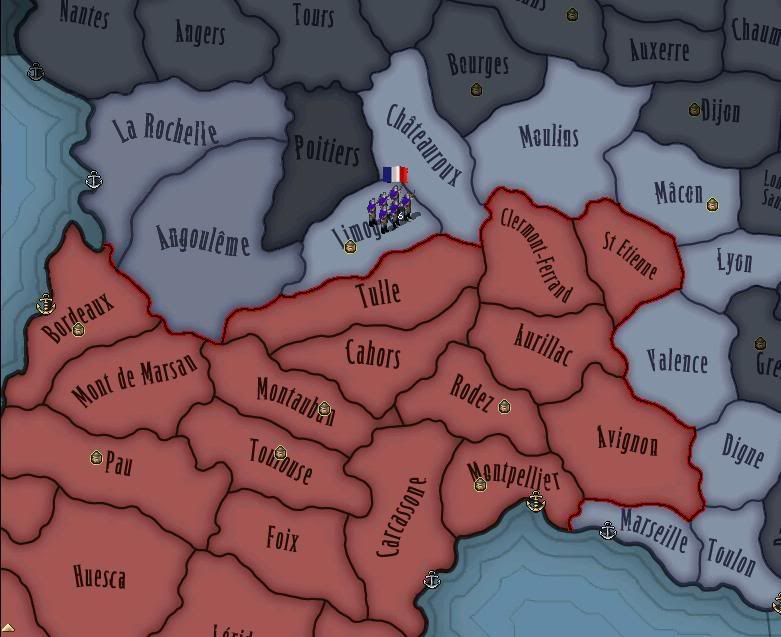
In 1742, however, the Treaty of Albi, France came in possession of the Frontier Provinces of France and Poitou, in change in the eastern part of Ceylon, whose invasion was imminent. In fact, the same year Granada withdrew the security on the island kingdom (the first given after the wars in the fifteenth century) and let the French landed in strength, easily conquering the last independent force on the island. General Delaville delivered personally to the governor Bagyan conquests and remained there until January of 1746 as a force of public policy.
The new frontier

The War of Ikkeri
During 1739, due to disagreements between people and rulers Kannada Swedish coast Malabar in Sweden was the scene of bloody riots against the Scandinavian settlers. Kannada I joined the small state of Ikkeri north and the king saw Kiriya Basavappa to the aid of neighbors and his army drove them out completely. This change
positioned in the Indian states worried neighbors. The Mysore, ruled by Krishnaraj Wodeyar II, having liberated the last legacies of the vassals of the Vijayanagara Empire, was left with the constant fear of invasion from the north or south. Delhi and Mysore and Ikkeri Granada feared that they could form an alliance, perhaps even Bengal.
The Sultan of Delhi proposed to mysore raja submission with a large degree of freedom in exchange would help the kingdom nell'annessione expanding.
Wodeyar, although hesitant, he agreed, the joint forces defeated those of Delhi and Mysore dell'Ikkeri and the raja became subject to Delhi, which thus ensured the supremacy in India.


Creative Camera Driver Live Pro Window 7

South-East Asia: the struggle of nations.

had just ended the war of Java that the region was again contested between several contenders.
More or less during the war of Rajput, Oman declared war with Brunei, which tore around the Borneo, except the north-west. The Ottoman sultan Sayif II persuaded the Granada from intervening to stop giving its naval base in Abu Musa to the Turkish fleet.
Ten years later, a coalition between Holland and England, Oman pulled almost all its colonial possessions: Badjarmasin went to Holland, England the rest of the territories in Borneo, Zanzibar, Bahrain and Qatar. 47 months later, the annexation Oman on the part of the Ottoman Empire, Granada took the last strip on the island, the region of Samarinda, the East.

In 1726, it was the turn of Sweden: the war between Holland and Sweden, the second conquered Palembang, Batavia, Luzon, Buru and Flores, giving the final blow to the VOC. In short, the government of the United Provinces completely took over the company.

however, was in 1730 that France peeped in those islands, relying on the sultanate of Brunei, the Navy established bases on Taiwan, Ceram and the south-east of Celebes. In doing so, he found himself in conflict with the Netherlands, an ally of Britain. In 1731 war broke out two "parallel" with England and the Netherlands, one against France and Brunei, the second against Granada and the Ottoman Empire, with the objectives of Oman on former possessions of both parties.

In one year the Netherlands took over Taiwan, but the navy grenadine prevented other movements of troops, after several battles and some naval skirmish land (including an attempted landing in Bahrain Arab-turkish), we returned to the status quo for all contenders. The tensions were still very strong and there were numerous incidents between the merchant and the port authorities of enemies or even earlier clashes between border troops in Borneo.


Can I Get Herpes From Sharing Hydrogen Peroxide

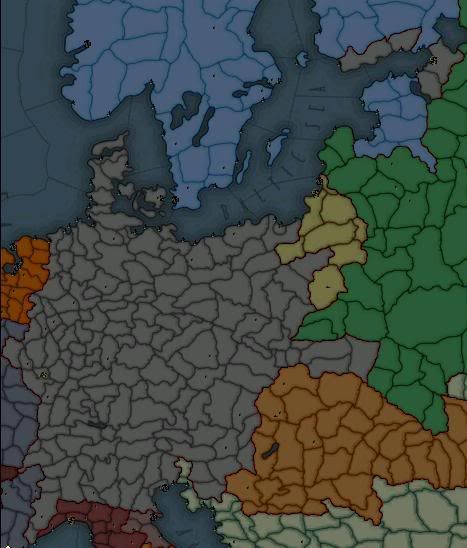
The world at the beginning of the War of 1700

The Holy Roman Empire: achievements and compromises
The era of Heinrich VIII was one in which the empire expanded more: the Emperor in fact intervened in favor of the Two Sicilies, at war with Venice for the Peloponnese. In the War of Verona, Venice was completely absorbed by the Empire, and became one of the states. He allied himself with the Tsar and then invaded Poland together, reducing it to a third party. In 1725 he won the Swedish invasion of German territory at the mouth of the Neva and conquered Nyland.
However, this expansion resulted in the demand for greater autonomy of the Electors, after they had provided most of the necessary force to these victories. So, forced from a territory too long and the first concord among voters for centuries, the emperor had to grant autonomy to his vassals in 1300. He ended the time of a centralized and unified Reich.

The western limit of the Ottoman Empire
Heinrich While fighting in Italy, the Sultan Ahmed III declared war on Poland, seizing the Podolia. Later, during the war against the Empire, Poland, had invaded Hungary to Bekr Bey Istria, who won with the victory of Ogulin. In 1718 he entered the turkish army in Trieste. It was the best I could reach: after several years, Russia and Hungary and took these regions.

The maximum expansion of the two empires.


Naples and Rome in 1704, with the bull "non datur," Clement XI declared invalid the primacy of the kings of Bourbon-Anjou on the Papal States and its total independence from any foreign nation. Despite the threat of excommunication, King Robert V continued to threaten war, everything was resolved with the mediation of France, with the Two Sicilies, which renounced its claims on the state but won the Papal Marches.

The Americas after major outbreaks
is around the beginning of the eighteenth century that epidemics struck the European continent again American. These diseases had already opened the way for the Europeans in many parts of Asia, especially in the Caribbean and southern North America, where in practice the English settlers were replaced by the native population. The same fate had many tribes of the east coast of the continent. Virtually all South America was harassed by them, except the Inca Empire. In fact, since the 1500 Incas had ruled that the only contact with the outside should be with the merchants who had passed quarantine, after the diplomatic expedition to Tenochtitlan had talked about what was hitting the empire.
Even the Aztec Empire during the reign of Momoztli I experienced the destructiveness of the disease overseas. A half of 1500, typhoid and smallpox struck the Yucatan and then expanding along with other diseases throughout Central America. In Tlaxcala, and in all the cities of Lake Texcoco, the population was decimated by 90%. However, the Empire resisted, because the British were still involved in the colonization of land east of Mexico. This crisis, paradoxically, strengthened the absolute monarchy, because it eliminates a big chunk of Aztec nobility (however, when the royal family was one) and also that of the population is Nahuatl, the latter supported the huey tlatoani in its decision not to close the their markets to Europeans.
epidemics still not completely exterminated the people and slowly natives developed some immunity to infectious diseases and their impact in the following century it reached levels similar to those in Europe. However, these bacteria were an important weapon for the Aztecs when they fought against the Navajo and Apache, often forcing them to abandon their territories.
In North America only two tribes of any importance were able to resist disease and wars with the British: the Hurons and the Iroquois. The Iroquois in the war against the British were infected with smallpox through furs sold by the British in which they were wrapped patients. After about two years after the Iroquois accepted the British protectorate, with a certain independence, to prevent the attack of the enemy Hurons.
These more distant from the colonies, were hit almost immediately after the Iroquois, but the distance from the British and their federation with the Algonquins throughout 1600 to ensure the continuation of the gang war.

Ultimately, the early eighteenth century most of the Americas had been suffering from these diseases.